Rudolf Steiner spoke of the urgent need to extend our view of the world with an awareness of its spiritual background. Without a spiritual awakening, he said, humanity was certain to cause harm to the environment and to itself. We have since had ample opportunity to see what he meant.
Steiner dedicated his life’s work to overcoming the prevailing materialistic worldview by giving teachings and practical impulses towards a general spiritual awakening.
“If it is correct to say that in the middle of the 19th century materialism was in a certain sense a test mankind had to undergo, it is equally correct to say that the persistent adherence to materialism is bound to work terrible harm now, and that all the catastrophes befalling the world and humanity that we have to experience are due to the fact that a great majority of people still tries to cling to materialism (…)”
– Materialism and the Task of Anthroposophy, GA 204
And yet Steiner did not believe that materialism had the last word:
“It is noticeable that in all parts of the world there are some members of humanity who are developing a longing to draw nearer to the spiritual world, notwithstanding the fact that materialism, alas, is not decreasing (…) For these reasons we must specify and bring before the soul our own search for the life of the spirit.”
– Materialism and Spirituality, GA 175
The problem, as Steiner saw it, was not science itself but a narrowing of the mind that accompanied it:
“This first great rise of the scientific way of thinking also led to a theoretical materialism accompanied by religious atheism. In a certain sense, atheism reached fever pitch among the materialists of the 19th century.”
– The Karma of Materialism, GA 176
Historian Christoph Lindenberg, in his monumental biography of Steiner, documents his life as a continuous struggle against restrictive materialism. In applying the same rigorously logical approach of scientific investigation to the non-material, Steiner expanded natural science with a science of the spirit.
Longing for Renewal
The turn of the century brought a general hunger for cultural renewal that intensified in the post-WWI period. Practically every field of human endeavour was affected.
Those who wanted to break with tradition to experiment with new forms and ideas were called avant-garde (French for the troupe at the forefront), and there were many across all of Europe.
Into this receptive hotbed of innovation, Steiner was able to plant a multitude of seedlings, each one transformative in its radical departure from customary forms:
- Dance was given a new impulse with Eurythmy.
- Drama was enriched with speech formation.
- Poetry and literature explored the spiritual nature of World and Self.
- Art replaced naturalistic representation with expressing inner aspects of reality.
- Sculpture sought to give form to spirit-forces.
- Architecture used the sculptural possibilities of concrete for multi-faceted construction.
- Education was to be child-centred and infuse life and learning with deeper meaning.
- Agriculture received the health-giving biodynamic impulse.
- Medicine and therapy were expanded through spiritual science.
- Science could unite with Goethean observation to integrate non-material aspects of phenomena.
- Religion abandoned the dogma of institutions for a personal reconnection with the divine.
- Business was to focus less on maximising profit and more on contributing to society.
- Politics was offered the far-reaching idea of Social Threefolding.
Social Threefolding is neither capitalism nor socialism, neither “right” nor “left”. It is a third way, a middle way that is not a compromise; not realised before but as relevant as ever:
“The economy must not buy the law, and the state must not own the economy or command the culture.” – Thalira
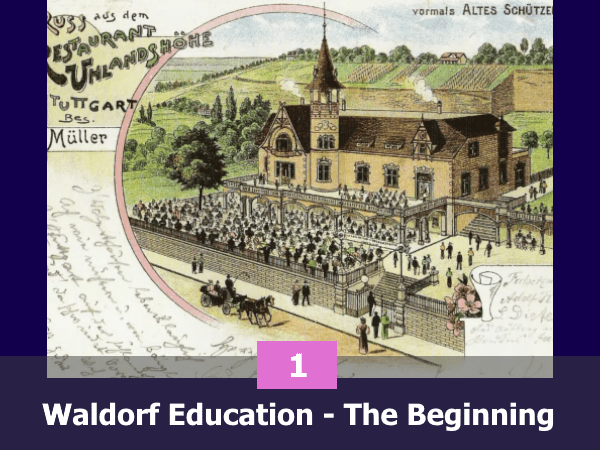
The breadth of Steiner’s response to the cultural hunger of the time is without equal. He was able to give a new impulse to practically everyone who approached him with a question – most notably to Emil Molt, who wished to found a school for his factory workforce.
Hurdles of Reading Steiner
Steiner’s reputation as an inspired innovator grew rapidly. His lecture tours drew large crowds in packed public halls. At times, people had to be turned away. In Stuttgart, Steiner addressed three to four thousand people per gathering – without a microphone.
Listeners wanted to preserve his words for the future, and so, against his initial wishes, stenographers took notes that were subsequently published.
The resulting 400 volumes of “The Lectures” outnumber the books Steiner wrote by ten to one. Also, they are prefaced with the caution that he rarely had time to proofread these transcripts.
There is a marked difference in style between Steiner’s own writings and the stenographs of his lectures.
The style of his books is rigorously academic, philosophically dense and in keeping with similarly demanding works of the time. It never panders to the masses and makes high demands on the reader’s mental focus.
Tip: If you suffer from insomnia, keep a volume of Steiner on your bedside table, for it can help you drop off within minutes. But should you remain awake, the time will be well spent with such study.
The language of Steiner’s lectures is more colloquial and progress less linear, but they are still not easy reading:
“Indeed, it is becoming clear to many people today – I would say – that materialism is no longer the way forward. But to penetrate into that which must be penetrated – if humanity is not to be led toward ruin rather than salvation in its cultural development – to penetrate into concrete, genuine spiritual science – this is precisely what I have often referred to as people’s inner psychological complacency.”
– The Karma of Materialism, GA 176
This was the task Steiner set before his readers and listeners: not merely to reject materialism, but to develop and strengthen the inner capacity required to understand the spiritual dimension of reality.
Cultural Renewal Interrupted
Had not a second world war, even more terrible than the recent one, begun four years after Steiner’s death, his seedlings may well have grown into a fruitful orchard.
In a long period of peace, the great spiritual awakening that was so urgently needed might indeed have come about, changing the course of history.
The ground was well prepared. There was an appetite for cultural and social renewal, an extraordinary flowering of new ideas and a generation keen to experiment.
But alas, the majority of Germans were seduced by the ideas of another Austrian expatriate: one who did pander to the masses, appealed to their basest instincts and brought them in a few years to near-total ruin.
That the German nation, holding its outstanding poets and philosophers so dear, should have been unable to choose good over bad (Rudolf over Adolf) when presented with two very different blueprints for cultural renewal – that remains a dark stain on its history.
A Devastating Setback
When WWII ground to a halt, the former hunger for innovative ideas was replaced by physical hunger, trauma processing, clearing rubble and rebuilding.
Initiatives established by Steiner’s students had been shut down by the fascist government. Now they slowly came back to life, but the ardent sense of working for cultural renewal, so prominent in the construction of the first Goetheanum in Dornach, had been extinguished by the war.
It proved impossible to pick up where things were left off. Too much had been broken; too many were killed, maimed or impoverished.
A cultural flowering, set to change the world for the better, had been blighted. And Steiner, whose keen insight and tireless work was needed more than ever, was gone.
But not entirely.
His spirit lives on in his books and lectures, though these need to be studied in depth and at length, lived with and revisited. Reading Steiner’s words does not automatically produce understanding.
This kind of study, demanding a high level of commitment and engagement, was not unusual in the pre-digital age. But reading Steiner can be an insurmountable challenge to generations raised on entertaining video clips.
Not many young Waldorf teachers are studying the foundational lectures anymore. And how could this trend be reversed?
The Anthroposophical Society, the guardian of Steiner’s legacy, was not directly affected by the war on account of being located in Switzerland. It continues to do good work, but it cannot be said that his hope of seeing spiritual science become a sweeping and influential movement has been realised.
A century after its founding, the Society has only about 42,000 registered members worldwide and continues to be met with suspicion, mockery or hostility.
Friedrich Rittelmeyer, establishing the Christian Community as a movement for religious renewal where women too are ordained, was reportedly admonished by Steiner: “If this does not become a large movement within fifty years, it will have failed.”
That same statement could also be applied to Anthroposophy as a successful movement for spiritual awakening and cultural renewal.
The Religion of Materialism
But Rudolf Steiner pointed out that materialism does not result in the absence of spirit:
“There is no doubt about it: we live in an age in which human understanding and human behaviour are gripped by materialism. But one must not believe that in this age of materialism spiritual influences are somehow absent, that the spirit, so to speak, is not active; that would be wrong.”
– The Karma of Materialism, GA 176
Materialism did win the worldview battles of the past century on the whole. And when threatened by a brief societal interest in the spiritual, it enlisted a trusty comrade: scientism, the quasi-religious belief that science is the only means of defining reality. “If it can’t be counted, it doesn’t count.”
Instilled into generations of schoolchildren, scientism has since become the ocular through which the world is commonly viewed.
Yet there is an intriguing quotation attributed to the Nobel Prize-winning physicist Werner Heisenberg:
“The first gulp from the glass of natural sciences will lead you towards atheism; but at the bottom of the glass, God is waiting for you.”
It is worth remembering that the glass has a bottom.
An Unexpected Reversal
The understanding that materialism is one worldview among many has largely been lost. The human race seems set on destroying the world and itself in a greedy race to exploit natural resources and maximise profit.
Wherefore one might reasonably conclude that Steiner’s impulse for a great spiritual awakening has been lost too. An understandable conclusion … But no!
It turns out that the spirit world does not give up easily. One might even say it has a terrific sense of humour.
Why?
Because it found a way to use two of scientism’s proud achievements against the tenet that the material world is all there is. One is the firmly Cartesian-Newtonian science of medicine; the other is the Internet.
Together, and unbeknownst to either, they are bringing about the great spiritual awakening at a speed and scope that would gladden Steiner’s heart.
And in case you are wondering: He did not foresee this surprising development.
The Great Spiritual Awakening
It began in the late 1960s, when cardiopulmonary resuscitation and intensive care were advancing to a level that produced a dramatic rise in successful reanimation.
The American philosopher and psychiatrist Raymond Moody documented cases of patients who were brought back from a state of clinical death and described what they experienced “on the other side”.
He coined the term Near-Death Experience and presented the phenomenon to a wide audience with his best-selling book Life After Life (1975). But NDEs were still regarded with suspicion and dismissed as hallucinations of an oxygen-starved brain.
Then Dr Eben Alexander, an American neurosurgeon, contracted bacterial meningitis that destroyed his cerebral cortex. Against the predictions of medical experts, he awoke from a deep coma with no lasting damage and wrote Proof of Heaven, describing how his NDE transformed his materialist view of the world.
“There is a lot to be learnt here that defies our assumptions of conventional neuroscience, leading to a much richer understanding of the brain, mind and the nature of consciousness,” he states in this interesting podcast.
His professional understanding of brain processes made his account particularly difficult to dismiss, but even so the scientific community could not accept it.
Dr Bruce Greyson, a psychiatrist and researcher, made the study of NDEs his life’s work and compiled a large body of carefully documented case studies.
As evidence grew to many thousands of cases worldwide, it became increasingly difficult to ignore. The radiation oncologist Dr Jeffrey Long, founder of the Near-Death Research Foundation, phrased it concisely: “What is consistently observed is real.”
In Spain, Dr Manuel Sans Segarra, a laparoscopic surgeon of Catholic faith, encountered NDEs in his own patients. Many were unwilling to talk for fear of being declared mentally ill, but his insistence on listening to their experiences led to his book Vida Después de la Vida (English: The Life Beyond).
In retirement, Segarra began to spread his insights into the relationship between science and our higher consciousness in lectures, interviews and his riveting YouTube channel Vida Eterna.
Pope Francis approved of his work and encouraged it. Segarra also conferred with the Dalai Lama, Dr Alexander and others. Though not an anthroposophist, he is an example of the well-informed, thoughtful mind and eminent voice Steiner wanted them to be in the world.
Of particular concern to Segarra is the rising number of suicides among young people, at a stage when they should be pursuing interests, projects and plans. His inquiries, he says, reveal a deep despair rooted in the impression that life has no meaning.
He attributes this inner emptiness to a school system that takes only material things into account, and to a society concerned primarily with the pursuit of wealth, social status and fame.
We see how this circles back to Steiner’s meaning-imparting spiritual concept of Waldorf education.
The School of Life
Meanwhile, people are learning about NDEs through podcasts, finding solace in vivid accounts of a higher reality.
The terms “life review”, “astral plane” and “Akashic Records” – so familiar to us from Steiner’s work – are now used unapologetically by people from all walks of life, having become mainstream via the mystic Edgar Cayce and the New Age movement.
Neuroscientist Dr Mayim Bialik, aka Dr Amy Farrah Fowler, hosts her own podcast Breakdown on NDEs and other spirit-related topics. Her intelligent questions and astute observations are a real joy, not only for fans of The Big Bang Theory.
Listening to NDEs on Coming Home, for example, we are struck by how explicitly things learnt from studying Steiner are confirmed by people who had no notion of his teachings, were not spiritual and even firmly materialistic, agnostic or atheist.
All returned with a changed mindset and gave a spirit-informed direction to their life, now knowing it to be a gift, a miracle and an exciting adventure of learning and improvement. “A schoolroom, not a courtroom.”
Their faces are moving to behold as they struggle to express powerful experiences for which human language has no words.

For a number of them, the “door” never closes entirely and they continue to be able to access the spirit realm at will – as Rudolf Steiner did.
And a very few subsequently find their way to reading his books on the higher worlds they glimpsed.
A Sweeping Movement
At the time of writing, it is estimated that in the timespan since the 1960s roughly 800,000,000 (that’s right: eight hundred million) people have had a Near-Death Experience.
This estimate is plausible because studies point to almost 350 million documented cases. Yet for every patient who told their story, at least two stayed silent, fearing ridicule and worse. Also, a high number of NDEs occurs in infants too young to express what they saw.
The scale of first-hand experiences of the spirit realm through NDEs is truly extraordinary.
Of these millions, not one person returned with their worldview intact, whether atheist or religious. Having been embraced by “Love beyond love, Light beyond light and Peace beyond peace” changed them profoundly, and they subsequently transformed their life.
Such transformation is never caused by hallucinations, as Dr Segarra points out. And all found God waiting for them, as the Heisenberg quotation says.
Dr Eben Alexander observes that they are “a large group of people whose experience shows that we live in a much grander universe than the bleak and paltry fiction of materialism.”
The irony is hard to miss: Materialist science developed excellent first-responder and surgical procedures for resuscitation, making a myriad first-hand reports of the “life beyond” possible.
(It is notable that those who are brought back to earthly life are not pleased, to put it mildly.)
Medical doctors may shrug off NDEs. But not the nursing staff: “We see it all the time.”
On the Internet, renowned professionals are presenting NDE investigations on platforms like the Oprah podcast, reaching millions of viewers and spreading spirit-knowledge.
Listening to these accounts, we watch with awe and wonder as the great spiritual awakening Steiner spoke of with such urgency is unfolding at last, in our time and before our eyes.
What This Means for Us
That brings us back to Waldorf matters, because we observe an unfortunate tendency in Waldorf Schools to curry favour with scientism at precisely the time when the zeitgeist is producing a growing interest in the spiritual dimension.
Eliminating Waldorf education’s spiritual aspects in order to make it more “contemporary” can only mean making it less aligned with the emerging spiritual awakening. That would be a big mistake.
Quite unexpectedly, technical advances of a triumphant materialism have created the conditions in which questions of higher consciousness and spiritual reality are able to spread fast, reaching millions who will never hear of Steiner and Anthroposophy.
But those who bring their children to us must not be disappointed. The spiritual foundation of Waldorf education is not an embarrassing relic. It is the very thing that makes it relevant to the world now emerging.
Steiner’s legacy puts us once more at the forefront, since there is no other method of education based on the deep understanding hinted at in our Second Morning Verse: “And Man to Spirit gives a dwelling in his soul.”
We do well to stand by it.
A WALDORF DIARY aims to preserve and spread the true spirit of Waldorf education