Many years ago, when I was a new and inexperienced Waldorf teacher, I was particularly anxious about teaching physics to my sixth graders. My science background was sketchy at best, and there seemed to be few resources to consult. How I wished for a book that would orient me in the subject and provide me with enough material for my classroom work!
Physics is Fun
Since none was available, I developed my own resources, and Physics Is Fun! was the result of my labors.
In the two decades since I first wrote this book, the new teacher’s dilemma has changed: Now there are many books and manuals for Waldorf science teachers.
In addition, the internet has become a pre-eminent resource. Instead of having too few resources, teachers now have too many, and it is difficult to choose among them.
I therefore decided to create a new edition of Physics Is Fun! to help teachers and homeschool parents navigate the overabundance of choices for demonstrations and activities that could be presented to their students.
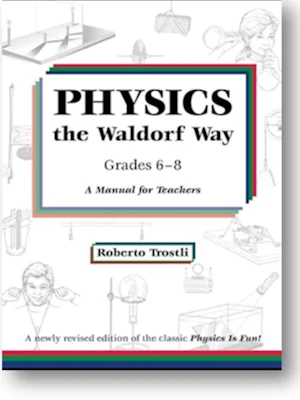
And I also wanted to share my decades of experience with a new generation of teachers. The following text is the introduction to the 2016 edition.
The Purpose of Teaching Physics
Why teach Physics? Like every subject taught in Waldorf schools, the study of physics is a means to an end.
What is that end? To nourish our students in soul and spirit and to help them develop into world citizens – people who know themselves, who understand and appreciate others, and who have a sense of responsibility towards the earth and all that live upon it.
To achieve these goals, teachers must strive to develop and strengthen the students’ capacities and abilities to apply their knowledge and understanding in meaningful and responsible ways.
Developing the Life of Feeling through Physics
In every subject we teach, we appeal to the students’ feelings, for through the heart, the whole human being is engaged. A wise man once said, “All understanding begins with wonder.”
The least, as well as the most impressive, phenomena can evoke wonder if presented and received in the right way.
Although students may act as if they have seen, heard, and done it all, they can still be moved and awed by simple phenomena such as a candle shining in a dark room or the whirling pattern of convection currents rising and falling in a fish tank.
Our physics lessons should stimulate curiosity by confronting students with mysteries that are not always easily unraveled.
The nature studies of the earlier grades were more directly comprehensible for students. They observed animals, found plants, or held minerals in their hands.
In physics in the upper grades, however, students will learn about forces that can be experienced only through their manifestations.
And as the students learn more about physics, they develop concepts that are keys to understanding the natural world, the world of technology, and the nature of the human being.
As Rudolf Steiner said, we are increasingly surrounded by and dependent on the tools and products of modern technology, yet most of us do not understand the principles governing many machines, devices, and technological processes.
By studying physics, students are helped to understand, appreciate, and accept the world that we have created. They learn to feel at home in the world and to approach their life tasks with confidence.
Developing Thinking through Physics
The upper elementary grades are a time of great change in the way students think.
In the first three grades, students think primarily in imaginative pictures. As children journey through the fourth and fifth grades, their observations and experiences begin to transform imagination into thinking.
By the time they enter the sixth grade, students are beginning to be capable of developing other capacities of thought: causal, conceptual, analytical, and deductive thinking.
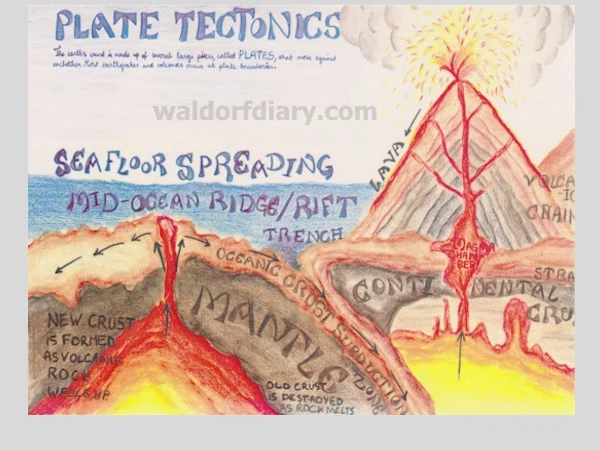
The study of physics addresses and develops these new capacities. The phenomena of physics can only be understood in causal terms because we cannot see the forces at work.
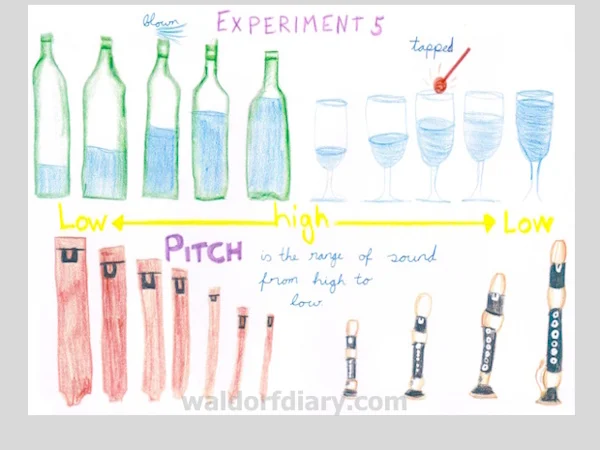
Pluck the string of a violin and a sound arises, loud at first, then becoming softer. The string vibrates strongly at first, then its vibration decreases.
What is the relationship between the vibrations of the string and the sound? The vibrations can be seen, the sound heard. Is sound vibration? Has it been caused by the vibration?
Such questions are central to the study of physics, and their answers demand that the students apply new capacities of thinking.
In our teaching of physics, experiences must be raised to the conceptual realm, for without concepts, physics remains a potpourri of experiences, interesting and even memorable, but not necessarily meaningful.
Students in the upper grades of the elementary school begin to become more objective. The capacity for objectivity develops slowly, and only after the age of twelve are students able to divorce themselves sufficiently from their own experiences to reflect upon them, to use their senses more consciously, and to analyze their perceptions.
Forming concepts is a mere intellectual exercise if it does not lead to a deeper understanding of nature and a fuller appreciation of technology.
Throughout every stage of their physics studies, students make connections between the subjects presented in the classroom and the rest of life. Science lives not in the laboratory but in the world.
While the scientist may discover some of nature’s secrets, any informed person should be able to read, understand, and appreciate the book of nature.
At the end of their physics studies, students should feel more comfortable, competent, and confident – better able to meet the world’s challenges and solve problems creatively and effectively.
Developing the Will through Physics
As we have seen, the study of physics develops and engages the student’s life of feeling and develops the new powers of thinking of the young adolescent.
It also promotes the healthy development of the will, of purposeful intention and action. The way we teach physics develops the students’ wills.
By observing the teacher’s orderly, methodical demonstration technique, the students are helped to form clear and orderly thoughts regarding the phenomena they are experiencing.
When the demonstration is reviewed the next day, the students recall what occurred, they account for the materials and procedures, and they formulate the concept.
Through such daily work the students’ memories are strengthened, and their thinking is infused with will. When the students engage in physics activities or investigations, their will is further developed.
The work of the scientist is logical and orderly. Although some great discoveries have occurred by accident, most scientific exploration requires scientists to follow specific procedures and to account precisely for what has been done.
As the students learn to plan their activities, formulate their ideas, and use laboratory equipment, they are strengthened in their capacity to work with purpose.
A Waldorf lesson is not complete unless there is plenty of time for the students to do their own academic, artistic, and practical work.
This is especially true in the physics main lesson blocks, for the bulk of the written work should come from the students themselves.
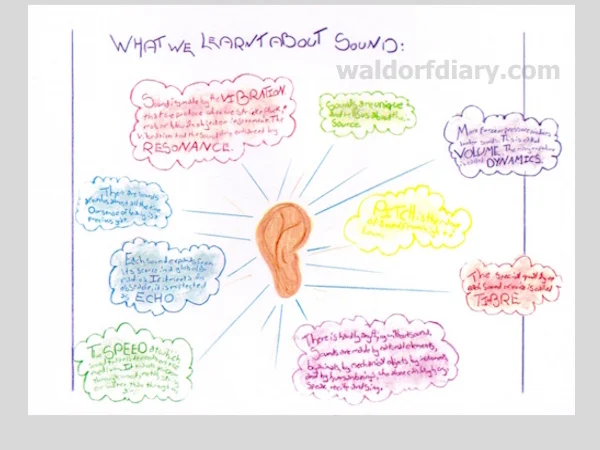
The teacher may help the students formulate a clear statement of the concept, but that concept is more meaningful when students write about or illustrate their experiences and ideas in their own words and images.
Awakening the Moral Forces
Like all subjects in the Waldorf school, physics places the human being at its center.
As students begin to perceive the physical world in a new way, they also learn how the structure of their bodies expresses physical laws – their eyes function like cameras, their legs and arms like levers.
In beginning to understand how the laws of nature manifest through physical forces, they also learn how humans have harnessed and channeled these forces through technology.
Technology may be used for constructive and destructive ends. In their physics lessons, students learn to work with materials and equipment in a purposeful and constructive manner.
This helps them to recognize that the earth’s problems can only be addressed by developing a sense of moral responsibility towards the material world.
The teaching of physics strives for the same goal as all other subjects: the development and cultivation of the students’ thinking, feeling, and willing.
We must keep this goal firmly in mind and not let the subject matter assume an overwhelming importance. The content of our lessons is a means to an end – not the end in itself.
Let us not forget that the essence of our work is what we do with the students. What occurs in them, what they are able to develop through our lessons, is much more important than the topics they study.
Methods in Teaching Physics
Waldorf education does not provide formulas for teachers to follow; rather, it demands that teachers develop pedagogical practices out of an anthroposophical understanding of the human being.
The foundations for this understanding were laid by Rudolf Steiner, but teachers must work to make it their own.
Through study, practice, and reflection upon our experiences, we can derive a method that truly addresses the whole human being.
The Foundations of the Waldorf Method
In Lecture 9 of The Foundations of Human Experience [free PDF], Rudolf Steiner analyzed and described the process of human thinking.
He wanted teachers to develop a clear understanding of this process since they were going to be particularly responsible for developing their students’ intellects.
Lectures 2 and 3 of Education for Adolescents review some of these principles and show how they apply to the organization of the lesson.
According to Rudolf Steiner, thinking occurs in three stages, which are interwoven and often occur simultaneously. He identified these stages as drawing conclusions, forming judgments, and arriving at concepts.
Note: Rudolf Steiner articulated a view of the human being that has both sensible and supersensible “members”. In this section, reference will be made to the ego – that imperishable part of our true self; the astral body – our “feeling body,” which allows us to have sensations, perceptions, and emotions; the etheric body – our “life body,” which is responsible for all of our life functions and also for memory; and our physical body – the mineral basis for our physical existence. If interested in learning more, see Steiner’s extensive descriptions in Theosophy and An Outline of Occult Science.
Drawing Conclusions
In Rudolf Steiner’s view, conclusions are perceptions brought to consciousness. Any sensory impression can become a conclusion, but only if we first become aware of it.
Often we have impressions of which we are not aware. For instance, we might hear – but not listen to – a sound. Hearing consists of perceiving sounds, while listening requires our active involvement.
We all have experienced being in a crowded room and hearing many conversations, but if someone mentions our name, we hear that word emerge from the cacophony of sound.
In order to draw conclusions we must, so to speak, listen to what we hear. We therefore draw conclusions about only some of our perceptions.
We continually live in the realm of conclusions. When we speak we express conclusions; when we listen to the speech of others, we draw conclusions; much of what we read remains in the form of conclusions.
According to Rudolf Steiner, conclusions can only live in the soul when it is awake. They are a result of the working of the ego, which helps us make sense of the world.
While conclusions affect the whole human being, they particularly affect the life of thought, for they serve as foundation for our judgments and concepts.
One of the main tasks of the teacher is to present the students with conclusions that can become the foundation for concepts.
If, instead, we present the concepts directly, they will live in students’ souls as conclusions that will not be capable of growing and developing further.
Forming Judgments
When we become conscious of our perceptions, we begin to form judgments. According to Rudolf Steiner, this process arises out of the human being’s desire to transform the process of perception into knowledge.
A conclusion consists of the awareness of our experience, but a judgment allows us to know that experience more fully and to relate to it. Our conclusions live in our sensory impressions; our judgments allow us to “make sense of” those impressions.
We do this by weighing our perception against our prior experiences and our memories of similar percepts from the past.
Judgments live in the dreaming soul, so we are not fully aware of them. They are a result of the work of what Rudolf Steiner called the astral body, that part of ourselves that allows us to have perceptions, feelings, and emotions.
While the drawing of conclusions only affects the way a person thinks, the manner in which a person learns to form judgments affects her life of habits, her very character.
Thus we teachers have a special responsibility to help students form judgments in a sound and healthy way.
Arriving at Concepts
Conclusions and judgments are inextricably linked. There is a constant interplay between our awareness of a percept and the process of linking it with our prior experience.
A conclusion is complete as soon as we become aware of it. The finality of a conclusion is well expressed in its German form, Schluß, which means “finished” or “done”.
The process of forming judgments is not over so quickly. We can continue to ponder and weigh our impressions for a while, but at some point, this process also must come to an end.
Concepts, on the other hand, grow gradually in the human being and must never be finished or fixed.
It is the teacher’s role to help the students form concepts in such a way that the concepts can grow and become increasingly well developed and refined.
Conclusions develop awareness, judgments result in knowledge, but concepts form the basis for wisdom, allowing us to understand ourselves and the world around us.
Concepts live in the sleeping soul, and unless we school our thinking, we will not become aware of them at all.
They are a result of the working of what Rudolf Steiner called the etheric body, that part of ourselves responsible for life functions and also for memory. The concepts we form have an effect on the physical body.
According to Rudolf Steiner, a mature person’s features and physiognomy reveal the types of concepts that were formed early in life.
This places a very special responsibility on the teacher to strive always to engender living concepts in the students.
While fixed or dead concepts result in the hardening of the soul, living concepts allow a person to remain mobile and flexible in her thinking, and they provide the basis for inner freedom.
Enabling Concepts to Grow
Let us take as an example a concept that is developed throughout the grades – the concept of light. Here are some of the many ways that children develop a relationship with this concept:
In the earliest school years, children experience light and they experience darkness. Their experiences are not brought to consciousness, but we know that these experiences make a deep impression on their souls.
In the early grades, children recite poems and sing songs that describe or express the light. They say the morning verse that begins, “The sun with loving light …”
They hear stories and legends involving light and the darkness. Through these experiences they form moral associations that will remain rooted deep in the soul.
In the third, fourth, and fifth grades, students are told about the creation of light in the stories from the Hebrew Bible and various mythologies.
And they also learn about light in their studies of the animals and plants. In their farming and in geography classes, they come to understand the effect of light on crops, animals, and people.
In the sixth-, seventh-, and eighth-grade study of physics, students begin to study light in all of its manifestations. They learn the characteristics of light, its behavior, its laws.
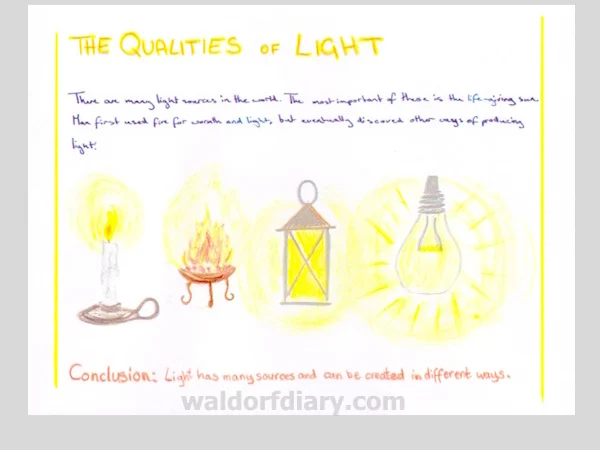

Now the concepts they form can be expressed in concise and concrete terms.
Throughout the high school years, students return again and again to the study of light. In astronomy and meteorology, in physics and chemistry, in economics and philosophy, they come to understand and express the many aspects of light.
During these years the concept of light grows ever more complex and also ever more refined. By developing concepts in this way, we help students to connect to the world and to trust that they can understand it ever more fully.

Roberto Trostli has been active in Waldorf education since 1981 as class teacher, high school teacher, adult educator, author, and lecturer. He received his BA from Columbia University and his MA from the University of Cambridge, England. After working as a violin-maker, Roberto taught for 10 years at the Rudolf Steiner School in New York City, which he attended as a child. Then he moved to Hadley, Massachusetts, where he worked for 18 years, first as a class teacher from grades 1 to 8, then as the founder and director of the Hartsbrook High School.
In 2009, Roberto resumed class teaching at Richmond Waldorf School, Virginia. He co-directed the part-time teacher training in Sunbridge College, New York, and served as Director of the Research Institute for Waldorf Education. He was a member of the Pedagogical Section Council for 10 years and helped with the re-structuring of the Association of Waldorf Schools of North America. He has also written numerous articles, plays and books.
Physics the Waldorf Way – The Structure of the Physics Main Lesson – The Demonstration – The Recapitulation – The Review – Experiencing Phenomena Through Demonstrations – Activities – Investigations – Projects – Written Work – Artistic Work – Preparation and Materials – The Task of the Teacher – The Topics to Study from Sixth to Eighth Grade

A WALDORF DIARY – the classroom log that makes the art of Waldorf teaching visible