
Anthroposophy inspires enthusiasm but also suspicion: Might this movement for spiritual renewal hide mechanisms which define a cult? For a well-founded answer, let us look at Rudolf Steiner’s legacy through the lens of cult analysis.
Regarding this question, a certain haziness of mind – I call it “fuzzy thinking” – easily makes assumptions and assertions, skips over the facts and reaches incorrect conclusions.
To gain a crisply contoured understanding of what a cult is, here follows the definition by an author who studies their structure in detail.
What is a Cult?
A cult is not necessarily religious. A broad spectrum of groups fits the term, but a shared trait is the intense devotion of its members and the promise of some sort of salvation.
Steven Hassan PhD explores the system of cults with the BITE Model of Authoritarian Control (free PDF) in his books Combating Cult Mind Control, Releasing the Bonds, Freedom of Mind, and The Cult of Trump. (See YouTube videos.)
Having personally experienced a cult and been rescued from it, he analyses the components of control with which charismatic men (rarely women) gain power over others and exert “undue influence”.
BITE is his acronym for how cults manipulate members by controlling four key aspects of their lives:
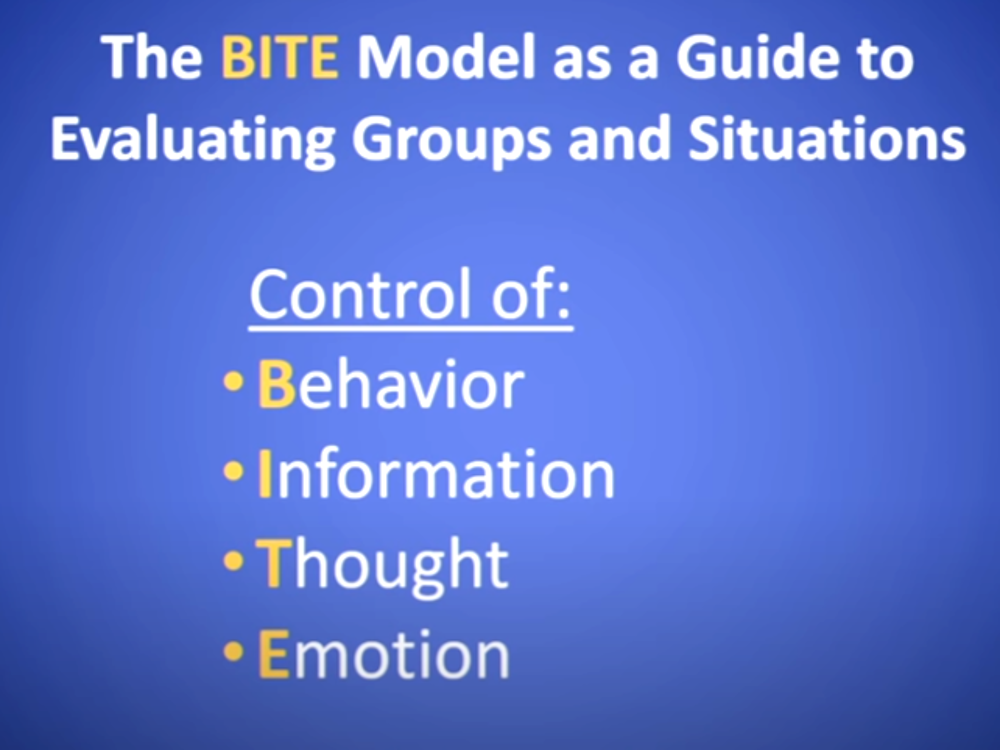
“How to tell if you’re brainwashed” TEDxBoston
Behaviour Control – Defining the Rules
The first need of a cult leader is to regulate his group’s environment, ordain where its members are to live and what rules they are to follow. This is most easily done in a place removed from society.
Clothing, hairstyle, food, love life, hours of sleep, finances, work, leisure and entertainment are regulated and may differ considerably from what is common.
Much time is spent with indoctrination and group rituals to eliminate individualism. Sleep deprivation weakens resistance.
Connection to the outside world is curtailed and demonised to create the mindset “We are right and have the answers, the others are wrong and misinformed.”
Decisions need the consent of the leader or are taken by him without any kind of accountability. His word is law; his rules create maximum dependency.
Rewards and punishments steer behaviour towards total obedience and submission.
Family members are separated and emotional ties cut to facilitate manipulation, psychological coercion and social pressure.
Disobedience is punished. In the most extreme cases, physical abuse and even torture are employed.
Information Control – Manipulating the Mind
The second need is deception. Information is withheld, or else distorted to conform with the set of beliefs. Lying about evident facts to influence members is routinely practised.
Other news sources are disparaged, forbidden or prevented, so that an alternative reality can be construed.
Mainstream sources are misquoted and statements used out of context to prove how evil and corrupt “the others” are.
Members are kept busy to stop them from investigating doubts. A buddy system for monitoring encourages spying on each other to report deviant behaviour.
The leadership produces propaganda materials to gain disciples. Books, newsletters, magazines, journals, audiotapes, videotapes and social media spread promises and marketing messages.
After new members have been pressured to make intimate confessions, their “shameful” information is used to bind them to the group.
Thought Control – Shaping Perception of Reality
Members accept the leader’s doctrine as the absolute truth. They alone are on the path to salvation, whereas outsiders are doomed.
To make them leave their former identity behind, changing their name to one bestowed by the leader is a useful tool.
Group-think is encouraged and rewarded. Loaded language, simplistic buzz words and phrases stop critical thinking. Clichés and platitudes prevent a nuanced approach to complex topics.
It is the clever use of manipulative language that makes a cult successful:
“Cults use language as a tool to manipulate, persuade, isolate, and control members. In most cases, these linguistic tactics are covert and seamless […]”
“[…] cult leaders lean on language that makes participants feel they are exclusive and knowledgeable. This draws a hard division between them and outsiders, who are inferior because they’re not ʻin the knowʼ.”
The Language of Cults: Persuasion and Control
Techniques of hypnosis gradually change the self-reliant adult mindset to powerlessness and obedience. The whole group is to be childlike and dependent on the leadership.
Memories are manipulated and replaced to suit the group’s alternative reality. Rational analysis is rejected, questioning forbidden.
Attempts at discussion are shut down with thought-stopping phrases such as, “We live in strange times.” – “It is what it is.” – “Everything happens for a reason.” – “We’ll agree to disagree.”
Denial, justification and wishful thinking are channelled with guided chanting, meditation or prayer.
In this way, a new map of reality is created in the mind, but this gaslighting can make members doubt their sanity and may even cause physical illness.
Note: Many of these techniques are also used to spread conspiracy theories that trap the mind in an escape-proof space of smoke and mirrors.
Emotion Control – Fear, Guilt, Shame
Last but not least: the range of feelings is narrowed by declaring natural emotions to be evil, wrong or selfish, thus instilling guilt and shame.
Emotion-stopping techniques block irritation, homesickness, doubt and anger. Members are to believe that any problem is their own fault, that they are unworthy.
Personal identity is invalidated. “You are not realising your potential. Your family is deficient, your past suspect, your affiliations unwise. Your behaviour is selfish. Your thoughts, feelings and actions are irrelevant.”
Historical, social and gender guilt can also be exploited to exert emotion control.
Irrational fear (paranoia) plays a key role. Fear of independent thinking, the outside world, designated enemies (i.e. family members on the outside), being shunned by the group, being possessed by Satan, losing the leader’s approval and therewith salvation.
Vulnerability is achieved with a rollercoaster of feelings between extreme highs and lows. Love-bombing and praise are followed by castigations.
Anyone wanting to leave is branded as weak, undisciplined, unspiritual, brainwashed by evil outsiders. Quitters would lose everything while having no life to return to.
According to group propaganda, leaving has terrible consequences. Possession by demons, dreadful accidents, diseases, insanity and an eternity in hell await.
Goals of a Cult
There are religious cults, political cults, commercial cults and self-improvement cults. Interestingly, the comparative study of otherwise distinct notorious groups reveals that their leaders had the same goals:
- absolute power and control
- amassing great wealth
- free labour
- unchecked sexual gratification
Total power is the top motivator and primary incentive, which is why cults are tyrannies. Wielding such power, cult leaders exploit their followers to get seriously rich.
L. Ron Hubbard: “If a man really wants to make a million dollars, the best way would be to start his own religion.” – (Quote: Los Angeles Times, August 27, 1978)
Once they have removed their flock from society and the reach of the law, they can go about sexual abuse camouflaged by spiritual authority. This is a key element of most coercive cults.
Experts have noted that practically all infamous cult leaders with a cold disregard for human life and dignity fit the clinical profiles of malignant narcissist, psychopath and/or sociopath.
Followers of a Cult
Why does anyone join a cult? Who values freedom and independence so little?
“Cults prey upon the vulnerable and insecure, such as teenage runaways, drug addicts, abuse survivors, those grieving a loss, those suffering from mental health issues, and anyone who feels disconnected from society.
Of particular fascination is the idea of losing yourself to find yourself. Cult movements proclaim that one must renege the previous personality and be re-born in the ideals of the group as a vessel for the ideology of the leader.”
(Open AI)
People without spiritual or religious education are more likely to get recruited when the soul’s basic need for worship makes itself felt.
Young adults looking for their place in life are especially vulnerable, unaware that the friendly people reaching out to them are part of a cult.
Insecurity and search for acceptance may make them join a group that promises salvation and exploits their need for belonging.
“When undue influence is initially imposed on the minds of unsuspecting recruits by extremist cults or pseudo-religious groups, it often starts with love-bombing and a promise of life in an idealistic fantasy world where they might never have to die and could live forever, achieve some elite status in a better society to come, etc.
Once recruits have bought into all the initial promises and hype, they are incrementally introduced into a systematic method of control, one small step at a time.
This methodical system of control – undue influence – disrupts the person’s authentic identity and reconstructs a new identity in the image of the group or leader. In the process, an individual’s ability to think rationally and act independently is undermined, enslaving even the brightest, most educated, and most functional people.”
Freedom of Mind Resource Center, free PDF
Note: “In The Culting of America, cult survivor, military veteran, and bestselling author of Uncultured Daniella Mestyanek Young delivers a gripping investigation into the invisible systems of control shaping our lives.”
Leaving a Cult
Cults make it notoriously difficult to leave the group. If they had nothing to hide, this would not be the case.
Dire threats intimidate, and secret-service-like operations pursue anyone labelled a traitor. At best, those who manage to escape are shunned; at worst, they die in mysterious circumstances.
A great deal of effort is needed to create a new identity, manage financial support and forge new social ties outside the group cocoon.
To anyone who knows even a little about Anthroposophy, all of this proves that Rudolf Steiner’s movement for spiritual renewal is not even remotely a cult.
But, especially for those who have no such insight yet, we shall explore further.
What is Anthroposophy?
That is a topic for another article, but this definition by Steiner is in Philosophy and Anthroposophy, GA 35:
“Under Anthroposophy I denote a scientific investigation of the spiritual world which, while cognizant of the limitations of mere physical science and ordinary mysticism, and before attempting to penetrate into the spiritual world, first develops in the soul faculties not yet evident in ordinary consciousness and science. The development of these faculties renders this advance possible.”
Uh, hang on … We need to read that at least twice, don’t we?
Steiner never employs simplistic slogans but demands effort and thought to a degree that puts many off a study that would likely prove fruitful.
It was his declared intention to make things this hard, precisely to guard his teachings from being parroted without understanding.
As a way to attract masses of followers, his approach is as ineffective and un-cultlike as can be.
The movement of Anthroposophy which began with his lectures is foremost an accurate and uncommonly deep study of the human being in relation to the universe and everything in it, including spiritual aspects.
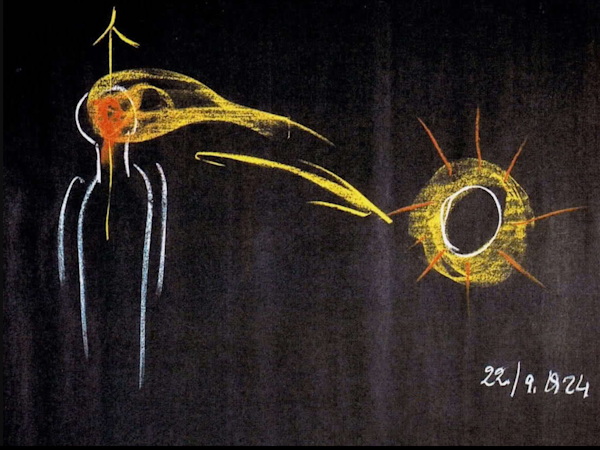
Rudolf Steiner’s Blackboard Drawings
This study is done in freedom. There is no need to sign up, buy expensive materials, leave family and friends, change the name, hand over assets and move to a reclusive community.
And yet, undeniably, Anthroposophy offers what most people hope for when joining a cult:
A worldview that makes sense and gives meaning to life and suffering; the security of a promising path of study to follow; an admired leader whose wisdom can be trusted, and a caring community to join and work with.
No wonder, then, that the free movement of Anthroposophy also attracts those who wish it were a cult and promptly try to infiltrate it with the BITE arsenal of undue influence.
Steiner is no longer around to rein in foolish followers, so others must do it in his place.
Anthroposophy – a Cult?
Some aspects appear similar to the fleeting glance and may deceive fuzzy thinking. Most notable are:
- The veneration of Rudolf Steiner as guru – a teacher of superior insight.
- The Goetheanum in Dornach, established as centre for the Anthroposophical Society.
- Vocabulary used to express spiritual aspects for which common language has no words.
- The behaviour of followers who seemingly abandoned independent thinking.
- Waldorf Schools which do not inform prospective parents about the link to Anthroposophy.
But a closer look reveals the differences, and contrast is stark:
- Cult leaders desire power and absolute control. Steiner was all about individual freedom.
- Cult leaders exploit their position of power. Steiner, a teacher and lecturer, did not.
- Cult leaders strive to amass wealth. Steiner lived on a modest income and remained poor to the end.
- Cult leaders often use their organisation as cover for sexual abuse. Steiner led a blameless life, as we learn from Rudolf Steiner: A Biography by Christoph Lindenberg.
- Cult leaders, seeing their position endangered by disciples who want to leave, must prevent this. Steiner, having nothing to fear, did not force anyone to remain loyal.
There are other differences too, but this list suffices to answer the title question.
Note: Probably uniquely in history, the re-founded Anthroposophical Society (1923) had a board of three men and three women. No fuss or proclamation was made about this singular gender parity which reflected Steiner’s attitude to women as equals. This too sets him apart, for cult leaders generally practise patriarchal fundamentalism.
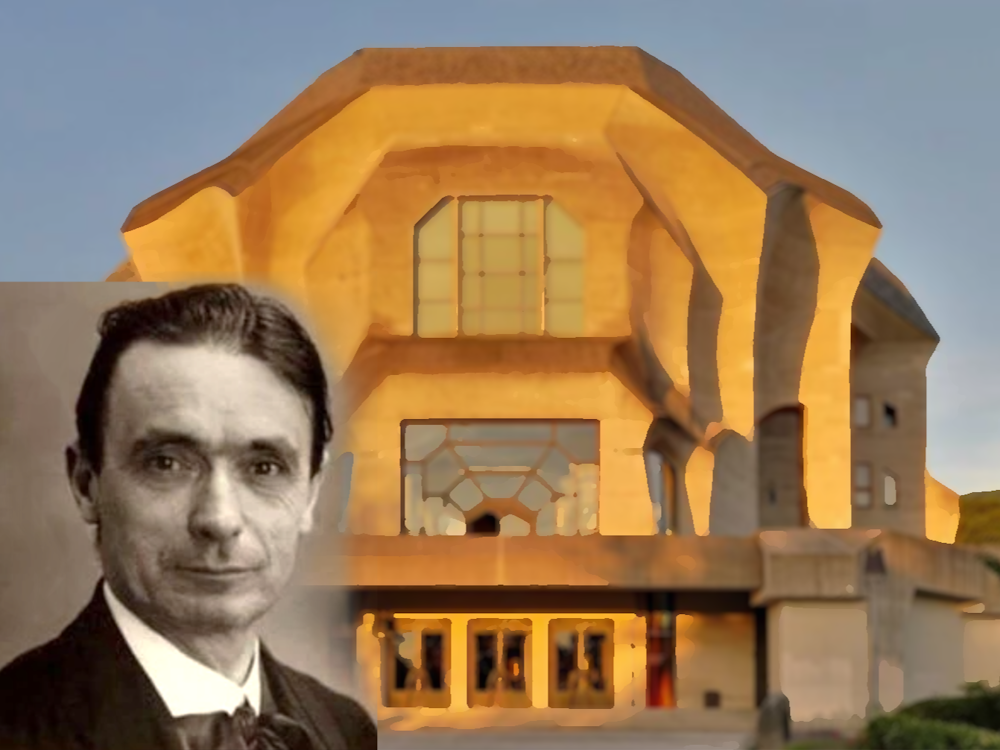
Building: Wladyslaw Sojka at sojka.photo / Montage: AWD
Revealing Anecdotes
Remarkably, it is not Steiner but misguided followers who are responsible for cultlike overtones.
He already experienced and deplored it in his lifetime, when widespread attitudes forced him to accept the relationship of a prophet to his disciples instead of primus inter pares.
“But Herr Doktor, we do so worship you!” someone exclaimed in dismay when Steiner criticised what had been said or done.
His exasperated reply was: “You are not to worship me. You are to understand me!”
(“Aber Herr Doktor, wir verehren Sie doch so!” – “Sie sollen mich nicht verehren. Sie sollen mich verstehen!”)
Emil Molt put to Steiner, “The question most people ask me when confronted with the term Anthroposophy is: Can you describe it in three words? What would you say?”
Steiner stated, “Doing your duty, selflessness, and contentment with destiny.”
Molt continued, “And what are the three things that most harm a person?”
“Untruthfulness, vanity and ambition,” Steiner replied.
(From Emil & Berta – The Origins of the Waldorf School Movement by Sophia Christine Murphy)
These and other anecdotes show that his convictions and attitudes opposed everything that makes a cult.
Note: Steiner was highly aware of the uncritical veneration he was met with and discreetly made fun of it. Walking with a friend around the building site of the Goetheanum one day, a piece of gravel fell into his shoe. Stooping to remove it, he commented wryly, “Otherwise, tomorrow all of Dornach will be limping.”
Cults vs Reform Movements
In fact, Anthroposophy belongs to the chorus of reform movements that began in the 19th century and continues to influence our world to this day. However, this is “due influence” and not the coercive-cult kind.
Each movement for the improvement of society is started by an unusually committed individual who dedicates his or her life to an altruistic cause and freely attracts a like-minded following.
Here are some influential examples, followed by notorious cults for contrast, comparison and clarification.
Leaders of Reform Movements
William Wilberforce (1759-1833) – British member of parliament; a conversion experience made him an evangelical Anglican and philanthropist. Championing religion, morality and education, he was persuaded by Thomas Clarkson and other activists to take on the abolitionist cause and headed the movement for 20 years until the Slave Trade Act was passed (1807). Retired for health reasons, but his campaign brought about the Slavery Abolition Act (1833) for most of the British Empire. Died three days after hearing that its passage through Parliament was assured. Buried in Westminster Abbey near his friend William Pitt the Younger. Opposed the pro-slavery lobby.
Film Amazing Grace with Ioan Gruffud, Romola Garai and Albert Finney
Leo Tolstoy (1828-1910) – Aristocratic Russian novelist and Christian anarchist; advocated pacifism, spiritual renewal and social justice. Did not want a movement in his name and urged people to follow their own conscience rather than blindly adopt his views. Active in Russia, he influenced the international vegetarian movement, Ludwig Wittgenstein, Gandhi and Martin Luther King Jr. Opposed institutional religion and state violence. Suffered state censorship.
Helena Petrovna Blavatsky (1831-1891) – Russian-born mystic and writer; co-founded the Theosophical Society with Henry Steel Olcott in the USA (1875), described Theosophy as “the synthesis of science, religion and philosophy” and claimed it revived the one Ancient Wisdom found in all religions. Active in Russia, USA, India (from 1880) and London. Gained an international following as a visionary advocate of her belief system; spread Hindu and Buddhist ideas in the West. Influenced the New Age Movement. The Society hosted Thomas Edison and Gandhi. Steiner and Krishnamurti left due to irreconcilable differences. Opposed by the British colonial administration.
Emmeline Pankhurst (1858-1928) – British political activist and suffragette leader; founded the Women’s Social and Political Union (WSPU), advocated militant tactics for women’s suffrage and helped them win the right to vote in Great Britain and Ireland (1918). A Times article stated that she “shook society into a new pattern from which there could be no going back.” The WSPU, reinvented as the Women’s Party, demanded equal marriage laws, equal pay for equal work, and equal job opportunities. Active in England, she also toured Canada, USA and Russia. Influenced later feminist movements. Criticised by moderates. Opposed by the British government and Home Secretary Winston Churchill.
Rudolf Steiner (1861-1925) – Austrian author and lecturer; influenced mainly by Goethe and the German philosophers. Initially found a receptive audience in the Theosophical Society, but his diverging views made him establish the Anthroposophical Society (1912). His manifold impulses for cultural renewal through a spiritual worldview led to the founding of the first Waldorf School (1919), the development of biodynamic agriculture, a more holistic medicine, the movement art Eurythmy and avant-gardist architecture. Proposed the Threefold Social Order as a viable alternative to capitalism and socialism. Active mainly in Germany and Switzerland, with lecture tours in many European countries. His first Goetheanum, built with donations and voluntary workers during WWI as a centre for the study of Anthroposophy, was destroyed by arson. He died two years later, and the second Goetheanum was built in concrete from the model he worked on in his last days. Influenced Wassili Kandinsky, Joseph Beuys, Michael Chekhov, Paul Celan, Andrei Bely, George MacLeod, Owen Barfield, Saul Bellow, Selma Lagerlöf, Michael Ende and others. Opposed materialism and social injustice.

Mahatma Gandhi (1869-1948) – Indian lawyer, anti-colonial nationalist and political ethicist; employed nonviolent resistance in the campaign for India’s independence from British rule. As leader of the Indian National Congress (1921), Gandhi strove to ease poverty, extend women’s rights, reconcile religious and ethnic groups, end untouchability and achieve self-rule. Adopted the short dhoti to honour the poor, lived frugally, fasted for introspection and political protest. He challenged the British salt tax with the Dandi Salt March (1930) and led the Quit India movement (1942). Active in South Africa and India; imprisoned several times. Influenced by Tolstoy, he inspired movements for civil rights and freedom across the world. Opposed by British imperialists.
Film Gandhi with Ben Kingsley
Jiddu Krishnamurti (1895-1986) – Indian philosopher, speaker and writer; adopted as a child by the Theosophical Society and raised to fill the role of World Teacher for mankind’s spiritual evolution. In his early 30s he rejected their teachings and disbanded the Order of the Star in the East that had been formed around him. In lectures about awakening to a higher state of being, he stated that “truth is a pathless land”, denounced organised belief systems and the notion of gurus, wanting to set people “absolutely, unconditionally free”. Active in India, USA and Europe, he befriended Aldous Huxley and founded five schools in India (from 1928), one in England (1969) and one in California (1975). Influenced educators and seekers. Opposed dogma and organised religion.
Martin Luther King Jr. (1929-1968) – American Baptist minister, political philosopher and activist; advanced civil rights for people of colour with nonviolent resistance and civil disobedience against all forms of legalised discrimination. Led peaceful protests to denounce racial segregation with the Montgomery Bus Boycott (1955-56) and the March on Washington (1963), where he gave his “I Have a Dream” speech on the steps of the Lincoln Memorial. Won the Nobel Peace Prize (1964) and was active up to his assassination. Influenced by Gandhi. Opposed poverty, the Vietnam War and segregationist authorities.
Nelson Mandela (1918-2013) – South African lawyer and anti-apartheid activist; became involved in anti-colonial African nationalist politics, joined the ANC (1943) and co-founded its Youth League (1944). Arrested (1962) and sentenced to life imprisonment for conspiring to overthrow the state. Liberated 27 years later, he was elected president (1994) and began dismantling the legacy of apartheid by fostering racial reconciliation; instigated measures for land reform, alleviating poverty and expanding healthcare. Awarded the Nobel Peace Prize (1993). Influenced by Gandhi and Martin Luther King Jr. Opposed the apartheid regime.
Leaders of Cults
L. Ron Hubbard (1911-1986) – American author of pulp science fiction; influenced by the English occultist Aleister Crowley, he founded Scientology as a pseudo-religion. His book Dianetics: The Modern Science of Mental Health (1950) was widely derided, psychologist Erich Fromm declared it a “mixture of some oversimplified truths, half-truths and plain absurdities”. Yet 500 auditing groups sprang up across the US, he set up the Hubbard Dianetic Research Foundation and took large sums without explanation. Escaped legal scrutiny by moving his organisation to a navy-like private fleet. Returned to the US (1975) and tried in vain to take over Clearwater, Florida. France convicted him of fraud (1978) and the US government indicted high-ranking members for systematic espionage. Reclusive final years in the Californian Desert, died of a stroke.
Paul Schäfer (1921-2010) – Paramedic in the German Wehrmacht; ran Christian youth groups after the war, was dismissed for “negative influence on youths and cultlike behaviour” amid rumours of sexual abuse. Friendship with the influential American preacher William M. Branham. About to be arrested and charged, he fled to Chile and established the isolated agricultural cult community Colonia Dignidad (1961), a cover for his persistent sexual abuse of boys. Openly misogynist, he separated all children in his group from their mothers. Smuggled weapons and collaborated with the Pinochet regime, enabling torture and murder of political dissidents on his premises. Untouchable for decades, the testimony of former victims eventually led to a warrant for his arrest. Went underground for eight years until caught in Argentina. Imprisoned (2005) in Chile, he died in jail.
Film Colonia with Emma Watson and Daniel Brühl
Jim Jones (1931-1978) – American leader of the Peoples Temple in Indianapolis (1955), then California (1965); prominent preachers William M. Branham and Joseph Mattsson-Boze endorsed his ministry and made him popular. His group lived a communal lifestyle of Apostolic Socialism and turned over income and property to the leader who directed all aspects of their life and admired Hitler, Stalin and Mao. Drugs heightened his paranoia, he warned of the enemy out to destroy his group. Negative publicity and rumours of sexual abuse made him build Jonestown in Guyana (1974) as a communist paradise removed from media scrutiny. The majority of its residents was black. Armed guards prevented anyone from leaving. “Let’s keep them poor and tired,” he said, “because if they’re poor they can’t escape, and if they’re tired, they can’t make plans.” When US Congressman Leo Ryan came with a delegation to investigate human rights abuses, he and five others were shot dead by the guards. To escape prosecution, Jones orchestrated a “revolutionary suicide” of 909 followers (276 of them children) with a cyanide-laced drink, while he himself chose to die by gunshot.
Bhagwan Shree Rajneesh (1931-1990) – Indian mystic and guru, lecturer of philosophy; his Rajneesh movement practised dynamic meditation for spiritual awakening, and “free love” which later led to allegations of sexual abuse. His followers were to live fully in the world but without attachment to it. In Mumbai (1970) he initiated followers known as neo-sannyasins, then established an ashram in Pune (1974) and attracted a growing Western following. When local government claimed a back-tax estimated at $5 million, he relocated to Oregon (1981). Conflict with citizens and the state government ensued, legal battles curtailed success. Asked the authorities to investigate his secretary Ma Anand Sheela and her clique for a number of crimes, including the first bioterror attack in US history, carried out with salmonella to manipulate the Wasco County elections (1984). Deported from the USA and refused entry by 21 countries, he returned to India, revived his Pune ashram and died there.
Charles Manson (1934-2017) – American singer-songwriter on the fringe of the Los Angeles music industry with a criminal past; attracted emotionally insecure individuals and social outcasts, mostly young women whom he treated as servants to be used at will. On the dark side of the Hippie movement (1960s), he took LSD, preached a mixture of Scientology, the Bible, Dale Carnegie and the Beatles and prophesied apocalyptic race war. Grew his group (dubbed the Manson Family by a prosecutor and the media) through drug use and “unconventional” (i.e. abusive) sexual practices, manipulated them into total submission and ordered the brutal slaughter of several people he disliked, among them the pregnant film actress Sharon Tate, wife of Roman Polanski (1969). Convicted of seven counts of first-degree murder, the death sentence deemed appropriate was no longer legal in California and he died in prison.
The Final Word
It all comes down to moral decisions. Does the leader of a movement choose to work for the good of others, or for the gratification of personal desires with “untruthfulness, vanity and ambition”?
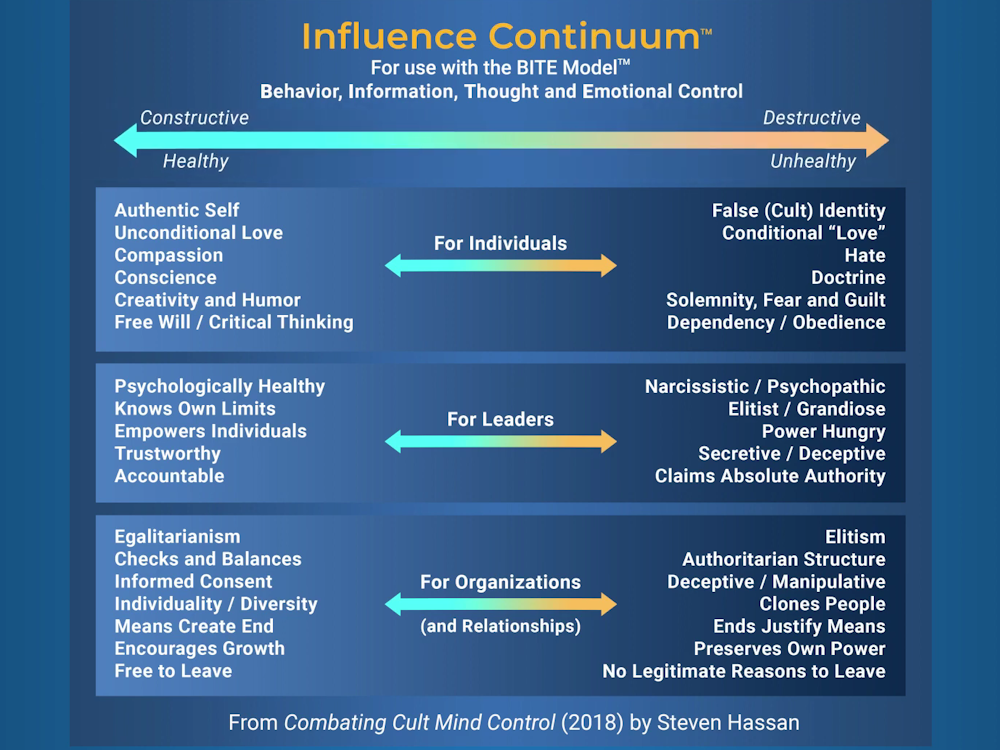
In the first instance, he or she will be the leader of a reform movement; in the second, the leader of a cult.
Ye shall know them by their fruits. Do men gather grapes of thorns, or figs of thistles?
Even so every good tree bringeth forth good fruit; but a corrupt tree bringeth forth evil fruit.
A good tree cannot bring forth evil fruit, neither can a corrupt tree bring forth good fruit.
Every tree that bringeth not forth good fruit is hewn down and cast into the fire.
Wherefore by their fruits ye shall know them.
Matthew 7:16-20, King James Version
To grow generations of “good trees”, we need to develop the children’s moral sense from infancy with Goodness, Beauty and Truth – three key elements of Rudolf Steiner’s Waldorf pedagogy.
Darwinist materialism in education and an almost exclusive focus on test results contribute significantly to mental health issues and societal ills – but that is a topic for another day and another article.
A WALDORF DIARY – the classroom log that makes the art of Waldorf teaching visible



Thank you for writing such an informative and comprehensive piece here Fabienne. I shall be sharing this in my school!
How splendid! Thank you, Hannah! 🙂
What a well articulated exploration of what a cult is and how people within Anthroposophy can bring the tendency of cult belonging into the Society. It is very important to articulate how Steiner was absolutely against this. This blog could be included in any study of Steiner. Nicely done.
Thank you! I am happy to hear that my exploration may be helpful to anyone with questions regarding this hot topic.
I wish I’d had this article to present to someone I know when she responded to a mutual friend who was considering sending her kids to a Steiner school. She described anthroposophy as a cult but I think knew about the school only through media reports. It can sound very strange to outsiders and I’ve never studied Steiner’s philosophy, only had experience as a student, so it was hard to respond in terms like your article does.
To offer this kind of help is precisely the intention here. 🙂
Well written, easy to understand and straight to the point! Great work!
Your words light up my day and are much appreciated. 🙂
It is possible to prove that anthroposophy is not a cult. It is also possible to prove that it is not racist, sexist, eurocentric, or even other negatives. But the problem is one of what Sartre called “Bad Faith”. Critics of anthroposophy make negative assertions because they want to and have no to wish to be persuaded otherwise and consciously avert their gaze from evidence to the contrary. They accuse anthroposophists of being irrational, mystical, etc, but it is they who ignore evidence and rationality in favour of a pseudoscientific approach. Sadly, a number of so-called Waldorf people and anthroposophists are now complying with this “Bad Faith” in favour of an exaggerated version of postmodern thought.
Interesting that Sartre was already aware of the phenomenon now called “haters” and coined a fitting term. Your observations call to mind what I wrote (2012) in a letter to College:
“Dear Colleagues, your discussion of the Waldorf science curriculum during the last two Thursday meetings raised the question: Would rewriting our ‘Yellow Book’ to make the statements therein scientifically watertight really stop the attacks on Waldorf schools?
I think not. Attacks made on our schools, and on Anthroposophy in general, always have two things in common: They are unconcerned with the facts, and they use emotionally charged terms like racism, religious sect, Darwin, unscientific, homeopathy and tax-payer’s money to whip up support without ever engaging in earnest, rational argument. It seems therefore quite pointless to invest our scarce reserves of time and energy in an attempt to present our schools as conforming to the current scientific doctrine. Even if we were to succeed in this (and I have my doubts), our opponents would drop the point and swiftly find something else to reproach us with.”
Very nice work. I recommend you also mention current guru’s like Maharishi from India (Transcendental Meditation) whose mission is to indoctrinate all schools with his form of meditation where children are programmed to read books blindfolded, and learn techniques for remote viewing. I know of at least one Waldorf inspired school who is offering his classes to children and parents.
Thank you! Indeed, I had more cult leaders on my list but shortened it because the article is rather long as it is. Readers may be inspired to investigate for themselves with the solid framework of the BITE model. Maharishi Mahesh Yogi is not exactly a cult leader, as AI summarises: “While the TM movement exhibits some characteristics commonly associated with cults, it also has aspects of a legitimate spiritual and personal growth movement. Whether one considers it a cult depends on individual interpretation and experience.” No true Waldorf School would accommodate Transcendental Meditation in their classrooms, surely, and the term “Waldorf-inspired” is hardly a guarantee for the real thing. Most critics of Waldorf Schools cite personal negative experiences, and my article wants to show that it is necessary to distinguish Steiner’s concept (the ideal) from humanly flawed implementations.