The Morning Verse begins the school day by positioning us in the world and centering us in ourselves. As a prime example of meditative poetry, it focuses the mind on its own place in the world, both in the inner and the outer sphere of experience.
Two Morning Verses were given by Rudolf Steiner in the first faculty meetings of September 1919. One was for the lower grades (1 to 4), the other for the higher (5 to 8). There was no Upper School as yet, or there might have been a third verse.

The teachers raised the question of having a morning prayer to cultivate a sense of reverence, integrity and gratitude, and Steiner responded by offering these verses. He commented:
“(…) Never call it a prayer (…) you will have to overcome a good part of the prejudice that this is an anthroposophical thing.”
“(…) Don’t demand that they learn it by heart! (…) It would be nice if they write it down, for then they will have it in their own handwriting.”
Both verses address the meeting of World and Self as the driving force of education and moral development.
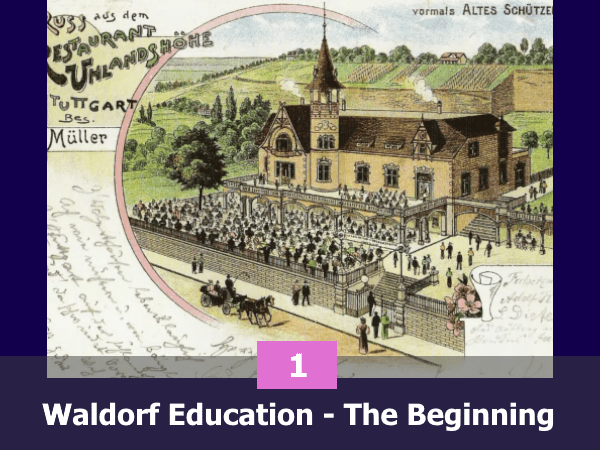
Now, for a better understanding of our topic’s spiritual background, let us approach it with a pertinent anecdote:
“What is different at your new school?” a young pupil who recently joined a Waldorf School was asked. She replied, “The teachers like each other, and they talk about the sun a lot.”
This child’s observation takes us into the heart of the matter: the nature and importance of the sun.
What is the Sun?
A detour of some magnitude is needed if we are to understand the sun as more than a ball of incandescent gas, so bear with me as we leave our topic for a moment.
Christian theology knows God the Father, God the Son and God the Spirit as the Holy Trinity. This One-as-Three and Three-as-One is expressed by our life-giving star:
The sun, a truly enormous ball of fire, radiates light and warmth. Its key aspects can be experienced and considered as three and as one.
Like God the Father, the sun itself is too intense for our physical eye, too unattainable for our touch, too vast and mysterious for complete comprehension.
Yet its light streams towards us, just like God the Son. This spirit-filled light permeates the world, illumines it for us and is our life and joy.
Sun and sunlight are both one and two. In the same way, the Father (source) is mightier than the Son (its outpouring), and yet the Son embodies the essence of the Father.
The third aspect, the sun’s warmth, corresponds to the Spirit of God: the feminine element, weaving between Father and Son. It is the interval that makes the other two possible as separate entities; the bridge, the relationship, the mother and nurturer – humanity’s healer.
Note: This threefoldness is also reflected in the Ur-Berufe, the primary professions. In these, all equally valuable, we see divine love in action:
God Father, the original Creator, resounds in gardeners, architects, builders, inventors, designers, artisans, poets, writers, composers, musicians, singers, painters, potters, sculptors and dancers.
God Son, the original Teacher, works through anyone who imparts knowledge to those who come after: mothers and fathers, grandparents, teachers, coaches, mentors, trainers, priests and lecturers.
God’s Spirit, the original Healer, is active in any personal or professional work that involves caring, cleaning, ordering, feeding, nurturing, supporting, rescuing and restoring – the essential aspects of family, community, celebration, therapy and healing.
For this moving thought, presented in one of many inspiring lectures on epistemology, religion and Anthroposophy, I am gratefully indebted to my late teacher Berthold Wulf (1926-2012).
The Spirit Forces
That there are mighty invisible forces at work in the visible world is easy to observe and has always been known.
Contemporary science invents names for these forces and develops theories to explain their workings with mathematical formulae.
“(…) Modern cosmology prefers to speak the precise language of mathematics, but what is to prevent us from understanding the equations of physics as abstract representations of the otherwise supersensible activity of spiritual beings? What, in other words, is to prevent us from linking that which is intelligible in the universe to that which is itself intelligent?” – Matthew David Segall
Note: Matthew David Segall, PhD, is a transdisciplinary philosopher and Associate Professor in the Philosophy, Cosmology, and Consciousness program at California Institute of Integral Studies in San Francisco. His work bridges process-relational metaphysics with contemporary science and spirituality, drawing inspiration from thinkers such as Whitehead, Schelling, Goethe and Steiner. His website is Footnotes2Plato
In the Christian Middle Ages, these intelligent forces were identified and named as nine groups of spirits classed in three ranks:
- Seraphim, Cherubim, Thrones – the First Hierarchy
- Kyriotetes, Dynameis, Exusiai – the Second Hierarchy
- Archai, Archangeloi, Angeloi – the Third Hierarchy
Below the angels is mankind. Above the First Hierarchy is the Holy Trinity whose active limbs the nine forces are: integral parts of the One-as-Three, yet distinct in their actions and effects.
Dionysius the Areopagite, and later Thomas Aquinas, wrote in detail of these nine “choirs of angels” whose names are Hebrew in part (after Isaiah and Ezekiel), and partly Greek.
An excellent summary by Matthew David Segall is his blog post Rudolf Steiner and the Angelic Hierarchies.
The Angelic Hierarchies
Here follows a brief outline according to traditional esoteric knowledge:
Seraphim are the essence of God’s love. Isaiah describes them as “the burning ones” circling the highest throne and singing praises.
Cherubim are God’s harmony, truth and wisdom, guarding the gate of Paradise. Ezekiel describes them with four faces: bull, lion, eagle and man – the esoteric symbols of the gospels.
The Thrones are God’s will, authority and justice. They have been depicted as interlocking wheels covered with eyes.
Kyriotetes govern and guide cosmic events and the flow of world evolution.
Dynameis are behind the laws of nature and the movement of celestial bodies.
Exousiai (Hebrew: Elohim) are heavenly warriors battling the opposing forces. Also known as Spirits of Form, it is they who transpose divine ideas into the physical shapes of the natural world.
Archai are the Spirits of Time. They flow into the Zeitgeist of historical epochs, are guardians of nations and guide the destinies of folk-souls.
Archangeloi are God’s messengers, a leadership council numbering seven. The archangels Michael and Gabriel are the most well-known and also play a part in Islam.
Angeloi are the guardian angels who accompany, protect and guide individual lives without interfering in personal freedom, and without taking the human view that death is a tragedy and the end.
Segall: “The fourth and final level of the hierarchies is composed of the Spirit of Freedom and the Spirit of Love, both of which await their full realization by human beings on earth.”
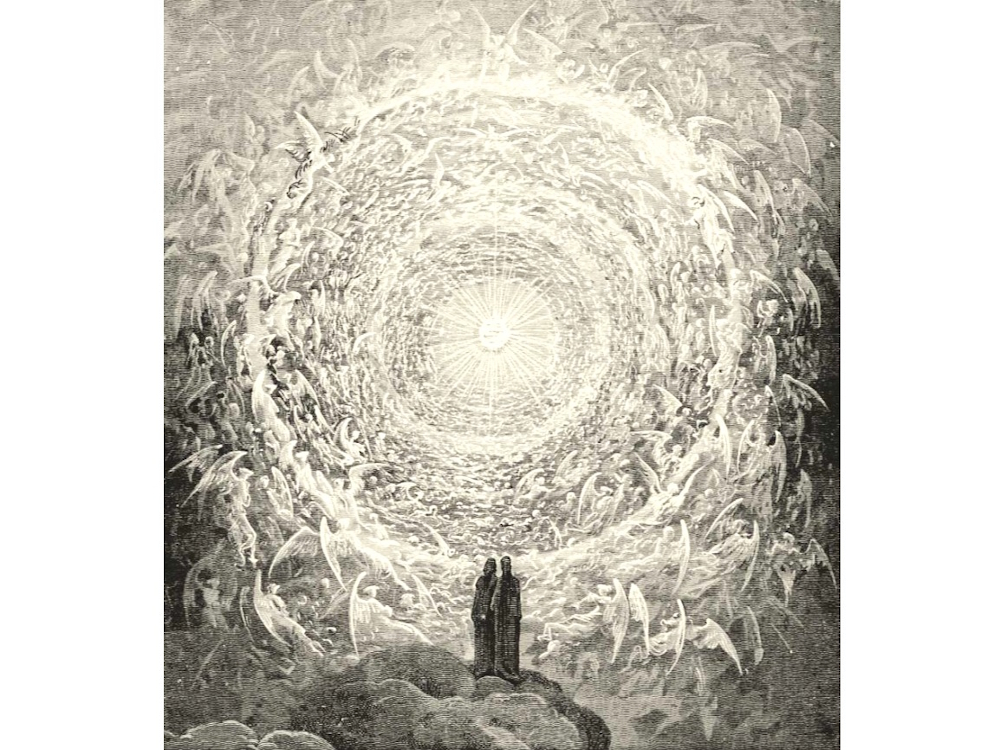
“Paradiso, Canto 31, The Empyrean”
Steiner described the hierarchies as involved in a dynamic process of cosmic evolution towards freedom and love, most extensively in lectures titled The Spiritual Hierarchies and the Physical World (GA 110).
The Sun in the Morning Verse
This brings us back to the Morning Verse, because – from the spiritual point of view – it is the combined force of the Second Hierarchy that powers the sun.
And because Kyriotetes are understood as lordships or rulers, Dynameis as dynamic powers and Exusiai as form-givers, it follows that, to the initiated, the concluding doxology (“words of praise”) of the Lord’s Prayer “For thine is the kingdom, the power and the glory” also means “For thine is the sun”.
With this in mind we are able to give proper resonance to “The sun, with loving light …” in the younger classes, and in later years to “Wherein there shines the sun …”
Meaning: God is with me every day and always. You can read the two verses here:
Do Waldorf teachers have to study this esoteric background? – No. It is not compulsory.
Does it benefit their teaching if they do? – Certainly. Because children, reading the adults around them, are subliminally aware if their teacher’s mind has depth and a level of understanding that is still beyond their grasp.
Natural, effective, non-verbal authority – so crucial in pedagogy – rests on such deep foundations.
The Essence of the Morning Verse
Rudolf Steiner wanted teachers to begin the first school year with the very essence of the world of visible forms: the straight line and the curve.

Simultaneously, he begins his first Morning Verse with the essence of the world of invisible forces: love and light.
Note: The twin concepts of love and light run like a golden thread through his entire work and are at the heart of his Mystery Dramas.
The Morning Verse, a Spirit Seed
Like every esoteric text from the Bhagavad Gita to the Bible and beyond, the Morning Verse works on two levels: that of the initiate and that of the unaware.
Steiner’s intention was that the teacher should speak its lines as one initiated into their deeper meaning, whereas the children speak it as purely meditative poetry. Carried by the rhythm and flow of its wording, they absorb the Morning Verse in a non-analytical, non-intellectual way.
Rather surprisingly, he did not say much about the Morning Verse. Here are two important quotes:
298. Rudolf Steiner in the Waldorf School: Address at the assembly at the end of the second school year, 11 Jun 1921, Stuttgart. Translated by Catherine E. Creeger:
“Life, my dear children, will ask a lot of you. It will have very specific requirements for you. Now, dear children, there is one thing that always will give you strength, always be a sun for you, and that is being able to remember being here in school and coming to love your teachers more and more.
It has a very bad effect on our life if we have to remember that we did not love our teachers and that we had no love for the subject or for what was on the blackboard or for what was being said or read out loud. It is always lovely later on if we can remember working hard and loving the teacher, but it is painful when we have to say to ourselves, “I was a lazy kid.”
That is what you should feel in every lesson. When you come to school in the morning and say your morning verse, you should remember that you are here to become a good and capable person.”
303. Soul Economy: Body, Soul and Spirit in Waldorf Education – The Waldorf School, 30 Dec 1921, Dornach. Translated by Roland Everett:
“When they assemble in their classrooms, the teachers bring them together by saying a morning verse in chorus with the whole class. This verse, which could also be sung, embraces both a general human and a religious element, and it unites the students in a mood of prayer.”
Are pupils thus indoctrinated with Christianity and Anthroposophy? – Certainly not. But they are familiarised with basic precepts in a way that neither affects nor diminishes individual freedom.
Fruits of the Morning Verse
Having spoken the Morning Verse for ten years as a pupil and for seven years as a teacher, I developed an intimate personal connection to its form and effect.
As a child I recited both verses dreamily, unfocused on the words and their meaning. They simply gathered the class at the start of the day as a starting signal for work and learning.
But like a seed planted in a favourable season, these words took root in heart and mind. Many years later, unforgotten, they blossomed into consciousness as I looked from a mountaintop at the sun-flooded world, as I watched the sun rise from the sea.
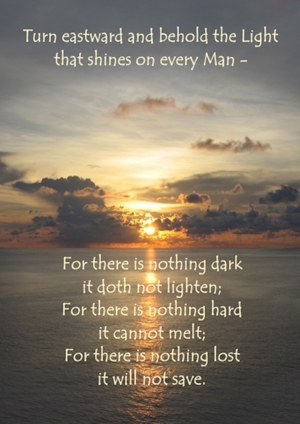
In these moments it was an indescribable joy to have words to express the majestic experience. My soul was nourished, my mind felt uplifted. And there arose deep gratitude for an education less concerned with short-term goals, and more with life in its profound entirety.
As Millicent Mackenzie stated 1924 in the preface to her book Freedom in Education:
“[T]here are things in life that are more real than bread and butter, more lasting than the clothes we wear. All that has permanent value is spiritual in nature, and the most solid facts in life (…) are those most truly spiritual.”
Note: Millicent Hughes Mackenzie (1863-1942) was the first female professor in Wales and the first appointed to a fully chartered university in the United Kingdom. She wrote on the philosophy of education, founded the Cardiff Suffragist branch, became the only woman candidate in Wales in the 1918 general election and was a key initiator of Waldorf Education in the United Kingdom.
Two Morning Verses in two languages, all equally dear to me: As I spoke the long-ignored words to myself, my adult mind focused like a laser on every phrase and delighted in the fruit of this silently sprouting seed.
What an incredible gift to have received!
And, by implication, what blinkered ignorance to neglect or dismiss the Morning Verse and delete anything to do with God from the curriculum!
To quote a beautifully concise summary by Christine Natale, “The Christ Being is at the heart of Anthroposophy, and Anthroposophy is at the heart of Waldorf Education.”
But that is a topic for another day.
Note: The Christ, as experienced and described by Rudolf Steiner, embraces people of all religious creeds. Waldorf Schools are therefore not Christian in the sectarian sense and are open to all.
Waldorf Schools are, however, teaching in a way that gives room and appropriate emphasis to the spiritual aspects of life. Guided by the insights of Rudolf Steiner, they are unafraid to contemplate and discuss alternatives to the notions of a historically recent and purely materialistic worldview.
Any school that distances itself from the ultimate reality called God, from Christ and Steiner and spiritual science (aka Anthroposophy) ought to drop the term Waldorf from its name and image; else it misleads parents and public and harms the concept of Waldorf Education.
“(…) This education is oriented towards drawing the method of education and teaching purely out of the human being, so that the whole human being – body, soul and spirit – may fully develop; but it also places the human being into life in such a way that, as a child, he grows in body, soul and spirit towards religious, ethical and artistic experience, and into the life of knowledge, and can develop within himself those virtues whereby he can be most useful and fruitful for his fellow human beings.” – Rudolf Steiner
A WALDORF DIARY aims to preserve and spread the true spirit of Waldorf education