
Bullying flourishes wherever an authority able to establish and maintain a safe setting is absent. Amongst children, this means any situation without adult presence, or adults thought weak and easily manipulated.
My own experiences across four Waldorf schools in two European countries were overwhelmingly positive, but I did witness, on occasion, how inept handling of bullying adds anguish to an already fraught situation.
As you can see from my blog index, I am interested in topics where people fail to distinguish between Rudolf Steinerʼs intentions and the practices arising from their (mis)interpretation by variously skilled teachers.
This article looks at the phenomenon of bullying in general and the crucial role of protective authority in particular, giving examples of manifesting it in the classroom.
Part 2 turns to bullying in Waldorf Schools. Which aspects of our culture reduce bullying, and which may unintentionally enable it? Does collegial governance diffuse responsibility and weaken protection?
Part 3 is about creating a school environment where bullying cannot take root, with examples of dealing with instances in firm yet creative ways. It also shows how to help bullying children achieve a swift return to their better nature.
Note: The methods described here are not for severe cases. Some bullying children have been so damaged by their circumstances that they need psychological intervention and therapeutic education in a curative setting. Schools cannot be expected to take this on.
What is Bullying?
Bullying is characterised by these key components:
- The intent to cause harm through intimidation, coercion, humiliation or violence.
- Exploiting the imbalance of power and status of one individual in the group.
- Repeated instances of harmful actions over a period of time.
This unwanted behaviour falls into several categories:
- Emotional bullying – rejection, humiliation, exclusion, social isolation
- Verbal bullying – name-calling, taunts, insults, threats, spreading rumours
- Physical bullying – pushing, kicking, punching, taking or damaging belongings
- Cyber bullying – inescapable harassment on digital platforms, widely shared
- Pack bullying – collective cruelty, abdication of individual responsibility
- Gender bullying – offensive comments, boundary violations, sexual harassment
It is important to distinguish between bullying and peer conflict. The latter is a disagreement between individuals of roughly equal power and status. Bullying means one side has more power and uses it repeatedly to dominate the other.
The emotional trauma bullying causes is known to have grave long-term consequences that may even lead to suicide.
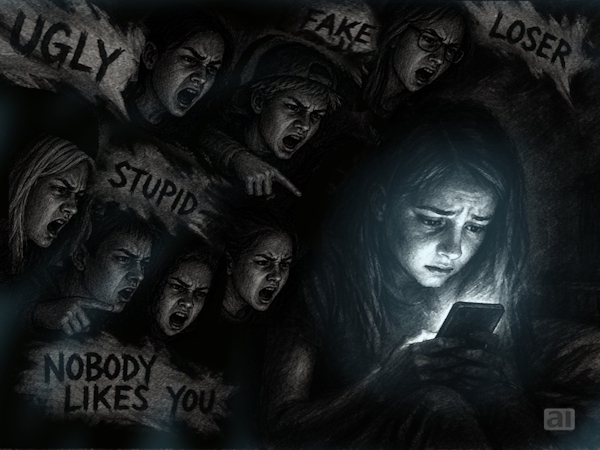
An Innate Dynamic
Humans have an observable, instinctive tendency to form tribal clusters. Historically, tribes lived for feuds and battles. Today, this primal us-against-them mindset lives on beneath the surface, ready to erupt whenever another group is perceived (or declared) to be a threat.
In the classroom, this tribal instinct often leads to the forming of an “in” group and an “out” group. The in-group tends to cluster around a powerful individual, a Big Chief or Queen Bee. But the out-group is a leaderless bunch, disunited and unable to make a stand.
Bullying happens when the in-group picks on out-group peers. Targets are declared “weird” and “losers” because they are different, vulnerable and – most importantly – unable to fight back.
This dynamic is just as rife in elite boarding schools as in the local comprehensive. It runs from classrooms via universities to the workplace, thriving in institutions.
Dominance behaviour is firstly about the gratifying sensation of power, secondly about being admired for wielding such power. Thirdly, it can be a strategy that saves an insecure individual from being bullied.
Distinct Forms of Power
Not all power is alike. In fact, there are two distinct kinds, one positive, the other negative, and the same goes for the concept of authority:
Negative authority is the oppressive patriarchal kind, rife in state and society, in institutions and the military. This authoritarianism is based on a hidden fear of appearing weak and is, in effect, bullying – coercive, harmful power.
Positive authority is a blend of competence, empathy and wisdom, able to create and maintain a safe space where everyone can thrive in peace. Arising from personal integrity, moral credibility, experience, love and care, this protective power is indispensable in education.
More on that in this article:
The negative power of coercive authoritarianism (bullying) depends on relationship, whereas the positive power of protective authority exists independently.
We can understand the difference through Christ’s exhortation to love those who hate you. A puzzling demand, impossible to achieve when love is taken to be a relationship.
The love that lives between the subjects of a relationship thrives as long as they remain committed love-emitters and receivers.
But Christ means and models a different kind: a love that radiates from the source without needing to be loved in return. Like sunlight, this (His) love shines on everyone – friend, foe and hater alike.
Christ is the original model of positive power, of authority springing from loving-kindness. Radiating from its source, this “one-way love” is entirely autonomous and needs no reciprocation to feed it.
Love-based authority’s positive power is independent of circumstance because it springs from the soul’s moral stature, as countless legends tell of eastern sages and western saints.
Fear-based authoritarianism’s negative power is a coercive relationship. It is never autonomous, for it needs enablers, disciples, supporters, cheerleaders, condoners and victims. Stripped of these, it ceases to exist.
Bullying at School
The workings of negative power are seen in politics, workplaces and families. And in the playground too, where children either imitate what they observe in the adult world, or experiment instinctively without role models.
Among children, an urge for negative power may echo experiences with abusive family members. In such cases, they are inflicting hurt on others as learnt behaviour.
But this is not always so. The pleasure of feeling powerful can tempt even the sweetest child from the gentlest home to experiment with bullying. “I don’t know what came over me!” they exclaim later, bewildered and remorseful.
Bullying among children relies on two things: the absence of watchful adults and the silence of targets.
This is splendidly illustrated in the setting of Hogwarts (a fictitious school familiar to nearly everyone) where the teaching staff is magically negligent in its duty of care.
Headmaster Dumbledore may be benevolent authority personified, but his eye is usually diverted. As for the rest of the teaching staff … Who has not felt the urge to tell them about adequate supervision? About child protection? About pedagogy, for that matter?
We see how sadistic behaviour passes from father to son in the Malfoy family. And how Harry, Neville and Luna as targets of bullying choose not to repeat this behaviour; unlike Snape, the bullied boy who becomes a bullying adult.
The Evil of Coercive Power
The structures of negative power are explored in brutal depth in the Swedish TV drama Ondskan, English title Evil. It shines a spotlight on diverse causes of bullying, concludes with the only way to stop it, and should be required viewing for educators.
The story shows bullying with a life-threatening level of violence and abuse at an elite boarding school for boys. Quietly complicit, the staff enables this abuse with the noble pretence of granting students a high level of self-determination.
Justified as a tradition of peer education and self-governance, students are to work out conflicts amongst themselves. And the school nurse who routinely patches up injuries remains silent, fearful of losing the job on which she depends.
The types of bullying woven into Harry Potterʼs story are even more visible here, thrown into stark relief for an adult audience. Not easy to watch, but truly enlightening.
In the end it is a mother, herself a victim of domestic abuse, who finds the courage and the legal means to protect her son, thereby putting an end to the school’s grim tradition.
What Can Stop Bullying
The brutality of coercive power in any form can be stopped by two things only:
1) In the short term, by a more powerful authority. Among children, this means the grown-ups in charge; and the children must be confident that these adults have the ability to deal effectively with bullying.
2) In the long term, by an education that is inclusive, raises awareness, models tolerance, teaches understanding, and replaces competition with amicable cooperation.
Dealing with Bullying
Whenever bullying occurs at school, the first question is what enabled it: Where did adult supervision and authority fall short?
An immediate investigation identifies the space, time and setting in which certain pupils feel empowered to mistreat others.
Next, a designated group determines how to change these enabling circumstances. Acting on behalf of the school, they embody a shared moral authority as guardians of what is good and right.
Having worked out how to make the presence of protective authority felt, they communicate the resolve not to tolerate abusive behaviour. Culprits must see themselves outnumbered and outgunned.
Note: Bullying experts commonly train victimized children to change mindset and behaviour to not get targeted anymore. Such training is valuable but takes time. In the first instance, without delay, it is the mindset and behaviour of perpetrators that must be addressed and helped to change.
Bullying in Early Years
For instances among young pupils, an informal approach is usually sufficient, as in this example:
Two boys of Class 2 and their targeted classmate are asked to stay behind as everyone is leaving.
The colleague who witnessed the incident in the playground is invited in by the class teacher, together with the three mothers who are waiting to pick up their child.
With grave face and calm voice, the class teacher informs the parents that there was an unpleasant incident today, and that their sons will now tell them what happened.
The boys who engaged in upsetting behaviour are asked to describe their actions in detail.
(The presence of their victim and the playground duty teacher compels them to honesty.)
Their mothers, though tempted to make excuses, must accept the facts now reiterated by the duty teacher, and finally by the mistreated boy.
Everyone gets to say, briefly and factually, what they did, saw, heard and felt. The class teacher insists that this is done without accusations, interpretations, judgements and “old history”.
Encouraged by the protective authority of his teachers, the targeted boy gets to describe exactly what upset him. Naturally, his hurt deflates the excuse that it was only a joke.
The situation is hardest for his mother, but her dismay reins in the desire of the others to excuse their sons’ behaviour.
The class teacher asks if she has questions, addresses these and assures her that her child will be kept safe.
(Making it clear to everyone present that, at school, each child is protected in the same way.)
Now the class teacher speaks of her disappointment with this kind of behaviour, which must stop at once.
She states that such incidents are taken very seriously and the entire teaching staff will be informed, so that they know to keep an eye on these three children wherever they meet them.
(Putting the necessary pressure on the culprits to mend their ways, and on their parents to support this.)
She asks the targeted boy and his mother to report revenge-actions at once. The others are told that repeated incidents will have grave consequences.
Finally, the offending boys are asked to apologise to their classmate, and to his mother, with a handshake. A simple “sorry” is not enough. They must express that they have understood the hurt they caused.
The class teacher sends everyone on their way with the heartfelt wish that this is the last time she learns of such behaviour.
A day later, she is told by the two mothers that, instead of letting their boys enjoy the promised play date, they each took their son home to do necessary chores around the house.
And at breaktime, the three boys are seen to play harmoniously.
Bullying in Later Years
Experiments with coercive power tend to occur more after a new pupil joins the class, and also with puberty.
Teenagers like to push against boundaries and need to be met with positive authority and the unbending law of school policy.
Now “Operation Thunderclap” comes into its own. Like thunder, it is sudden, forceful and impressive without inflicting harm.
Adolescents respect adults whose authority is positive, calm, confident and authentic. For a successful intervention, a designated group of five such adults is ideal.
(Five being the smallest number needed to make a circle.)
The class teacher is not part of this group, to keep her from becoming the target of unreasonable parents and disgruntled pupils.
Operation Thunderclap
Having sought an urgent meeting with the class teacher, a mother is close to tears as she recounts the verbal abuse her son receives from a close-knit group of three classmates.
It happens every breaktime, behind the back of the duty teachers, and has been going on for some time.
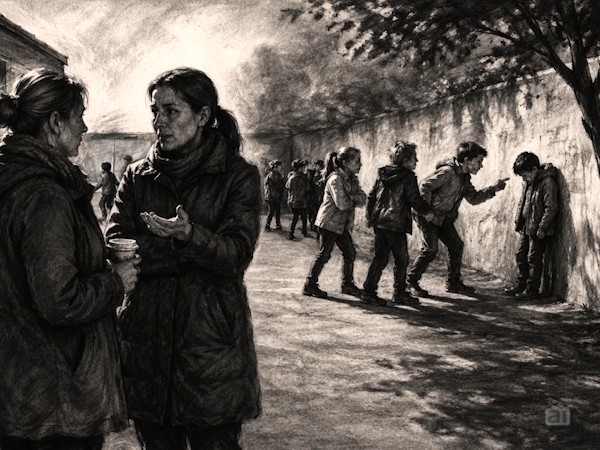
Her son kept quiet, fearing to make things worse if he speaks up, and implored his mother not to tell his teacher.
The teacher expresses her sympathy for the suffering of boy and mother. She had no idea this was going on and is dismayed.
Indeed, the mother did the right thing in exposing the bullying! This will now be resolved, and her son will have to endure no more of it.
Once known, the situation can be taken care of immediately and effectively by the designated group of teachers.
(All know the individuals concerned, having taught the class various subjects over the years.)
After the class teacher has informed the group, Operation Thunderclap takes its course, to which she remains a silent witness.
It is important that her class, except the targeted boy, does not realise she knows.
(Saving the good relationship with their class teacher makes it easier for culprits to mend their ways.)
The next morning’s first lesson is interrupted by a loud knock, reminiscent of St Nicholas and his moral authority.
The teacher opens the door, and the sonorous voice of the Chair of College (or headmaster) is heard:
“I need to see Peter, Paul and Mary in my office right now.”
The class looks at each other in alarm. This has never happened before … What is going on?
(Their faces show that they know about the bullying and instantly make the connection.)
As their peers rise with disquiet and approach the door, the power they wielded fades with each step.
(Everyone sees it, glad to have had no part in the bullying.)
The teacher closes the door behind them and continues the lesson, but the pupils are finding it hard to concentrate.
(Thoughts are with their friends’ uncertain fate, and so this becomes a valuable lesson for the class as a whole.)
The three culprits are taken to a staff office without explanation.
(They have not been there before, which adds to their trepidation.)
A ring of chairs awaits, and they are led to the free places to complete the circle of silent and serious adults. Nobody speaks until the Chair asks them to tell what they have been doing in breaktimes to their classmate.
(Although it is not mentioned, they sense that everyone is informed and the game is up.)
Haltingly and shame-faced, each one speaks of their involvement, prompted to be precise. One of the adults takes notes in writing.
(By this point, they fervently wish they had behaved differently.)
Taking turns, each adult addresses the pupils, speaking from the heart without scolding. No negative power is exerted.
They express affection and concern, alert the culprits to the suffering they inflicted and remind them of their better selves.
(It is known that these are good children temporarily gone astray.)
Then the Chair conveys the serious message that they are putting their place at risk with such behaviour.
He reads out the school’s anti-bullying policy which leads to permanent exclusion in three steps.
Is this understood? The pupils nod, acknowledging that this incident is recorded in their file as the first of these steps, and that their parents are called in to be informed.
(The intermediate step is a temporary exclusion of one week, followed by an interview with parents and pupil, and his or her written commitment to the expected behaviour.)
The meeting ends with a question: Would the three like to add anything?
Unprompted, each one apologises sincerely and with obvious remorse.
The lesson is just ending as they return to the classroom, damp-eyed, emotional and unwilling to answer the questions of concerned friends.
(The only cheerful face is that of the victimized boy, on whom nobody focuses.)
The class teacher has arranged to be on playground duty that day, so that she can keep an eye on the group.
And because she is perceived as uninvolved, her relationship with the class is unaffected by this incident.
A follow-up with the mother of the bullied classmate confirms that the situation has changed:
No more abuse, normalised interactions with the peer group, and a happy son who is no longer afraid to go to school.
A WALDORF DIARY aims to preserve and spread the true spirit of Waldorf education



Liebe Fabienne, das ist wirklich ein sehr hilfreicher Artikel für den Umgang mit Mobbing in jeder Beziehung – nicht nur in Schulen. Vielen Dank dafür!
Freut mich sehr, dass er dir gefallen hat!
Thank you Fabienne for this very informative and interesting post. ♥️
So nice to hear that you liked it, dear Corrie!
Very useful article on an important topic! I appreciate the practical school scenarios you described. Those would give me a confidence in children’s wellbeing as a parent and guidance as a teacher!
Thank you, dear Ivana, for underlining these two key points, and for your contribution to my research.
I am so impressed by your sensitivity and wisdom, Fabienne! I wish that I, and my school and colleagues, could have dealt with situations so effectively. Thank you for sharing this!
Your feedback always means a lot to me, Roberto, and I am happy to hear that you value this investigation.
This is an excellent post. I would like to see a follow-up on how to deal with the same power dynamics among Waldorf professionals. This problem is not limited to students.
Thank you, Jennifer, for your kind words. You are right, of course, about the problem not being limited to students. If someone writes (or has written) about this, I would be happy to link to it from my article.