From the very first day at school, as teachers we aim to prevent bullying by modelling understanding, inclusion, respect, empathy, tolerance and responsibility. And through the years, we guide and train the children in our care in the daily practice of these slowly growing social capacities.
As outlined in Part 1 and Part 2 of this article, grown-ups must step in swiftly to make protective pedagogical authority felt whenever bullying is discovered among children.
In Waldorf Schools, this ought to be easy. Smaller classes and an unbroken stream from kindergarten to the final examinations mean that our staff knows every child, its siblings and family circumstances. Class and subject teachers witness the social dynamics of each group and see it evolve across the years as the students grow.
A Waldorf School’s parent body is commonly more involved (i.e. above average) in the education and strives for a happy and healthy homelife that meets the children’s needs with age-appropriate activities and routines.
But even in an ideal setting it would be impossible to eliminate the deeply human us-versus-them mindset without a dedicated approach.
To counter deep-seated tribal instincts with education takes time, but it is certainly worth it and may begin with the thoughtful use of seating plans, as described in this article:
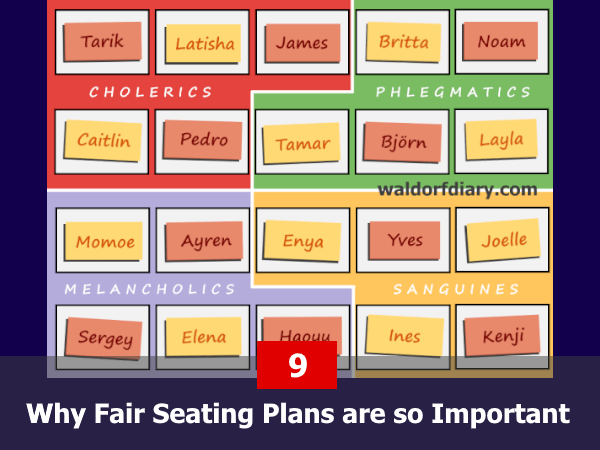
Pre-empting Bullying
Naturally, experiments with coercive power happen more in breaktimes than in lessons. That is why playground supervision is absolutely essential and must be prioritised.
Effective supervision means two duty teachers per play area. And they are not to stand together in conversation, oblivious to what is going on at the fringes.
They are to patrol the entire space separately, constantly on the move with a friendly but watchful eye, looking out for vulnerable pupils, scanning group dynamics, checking bathrooms and hidden corners.
In this simple way, much mischief and unhappiness can be prevented.
When bullying occurs, it usually happens in blind spots, dead corners and transition between lessons, practically always behind the back of the adults in charge.
Even so, peer cruelty may occasionally show up openly in a lesson, especially as the result of a dare.
Taking Decisive Action
Building an environment where bullying cannot take root relies on several concerted steps:
- Making authority visible and acting quickly
- Involving colleagues and parents
- Protecting targeted individuals, removing secrecy
- Guiding culprits to insight, remorse and apology
- Creating a frame for reflection and accountability
- Returning swiftly to normality
Bullying is always a serious matter, whether it be name-calling or physical violence, but the process of dealing with it must not attach labels that become a permanent identity.
Let us look at two scenarios from the Middle School years. The first was flagged by a concerned parent, and the second required quick thinking on the part of the teacher who was present.
In either case: Once the situation had become known, action was taken immediately.
Breaking the Silence
Reported incidents of targeted peer cruelty make you use one of your own subject lessons with the class for a talk on the topic of bullying. Keeping this talk general, you aim to break the wall of silence and raise awareness by inviting everyone to contribute.
And contributing is not optional, not left to the habitual volunteers while the others stay silent. You are communicating the expectation that every member of the group needs to participate actively in this talk about a matter that concerns everyone.
Asked to describe various forms of bullying they can identify, the students observe that with boys it is commonly about differences in size, strength, power and “manliness”.
A group display of male dominance behaviour targeting a younger, weaker or more effeminate boy is generally meant to intimidate, but it may also lead to physical violence with bodily hurt and harm.
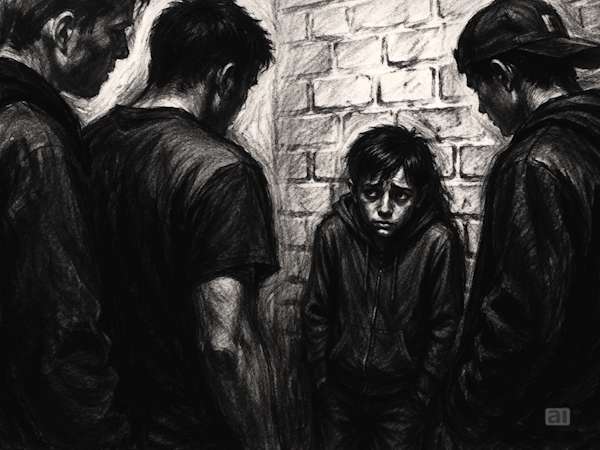
Note: These dynamics are described in depth in Masterminds and Wingmen by Rosalind Wiseman, “a landmark book that reveals the way boys think and that shows parents, educators and coaches how to reach out and help boys overcome their most common and difficult challenges.”
The class knows from their own history that, with girls, bullying tends to be about weaponizing friendships, looks, popularity and fashionable accessories, often resulting in the forming of a power-wielding clique around a Queen Bee.
In addition to the social exclusion of misfits, girls usually favour the non-physical violence of employing “poisonous words” with taunts, lies and rumours that cause emotional hurt and harm.
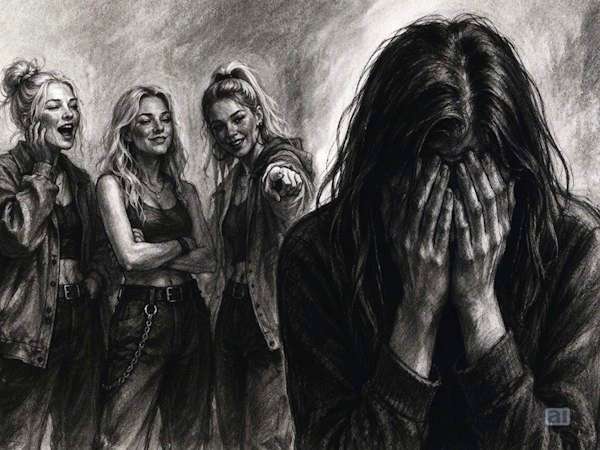
Note: These dynamics are described in depth in Odd Girl Out: The Hidden Aggression in Girls by Rachel Simmons, a book that “provides guidance for parents, educators, and girls to foster emotional honesty, open dialogue, and direct conflict resolution.”
Some classmates recount their experiences in earlier years, but the current incidents are not brought up and no one is shamed. Every contribution from the group builds the picture – seen by them all – that they know well how nasty bullying is and what damage such behaviour can do.
You end the lesson with a conclusion that leads over to action:
It is your duty to report any kind of bullying to your teachers and parents, because only then can it be stopped. I have been informed of two recent incidents, and those involved will see me straight after lunch to explain themselves.
The fact that you do not mention names and don’t give away how much you know makes the culprits assume that you already know everything and it is pointless to invent excuses.
After lunch, the class goes to the play area while the few who engaged in bullying come to your desk. Having asked them to describe their part in the incidents, you listen quietly, project presence and authority, and then calmly say what needs to be said with a few well-chosen words.
(Less is more, and you come prepared.)
Victimized peers are not part of this process. You spoke with them earlier and got all the information you need. Now the playground duty teacher monitors them and the rest of the class, and later reports how well the group behaved.
(This is essential for preventing further aggression.)
In the following lesson, as previously arranged, a colleague plays ball games with the class outdoors, so that you are free to be with the culprits who are now writing letters of apology in the classroom: one to the classmate they targeted, and one to their own parents.
Writing letters makes them engage on a deeper level, having to search for the words that express thoughts and describe actions. Writing it all down also creates true accountability.
(And the awareness that the rest of the class is now enjoying games outdoors shows the concept of “punishment” as a natural consequence of reprehensible behaviour.)
After the lesson, witnessed by yourself and the entire class, each one in turn gives their letter to the bullied classmate with a handshake and a verbal apology that needs to express understanding of the hurt that was caused.
The second letter – a factual description of the incident to the parents – is to be taken home at the end of the day and returned with their signature.
The parents are alerted to the arrival of this letter with a phone call from the school office, so they will know to ask for it. Placed in the pupil’s file, this signed letter is kept on record as an integral part of the school’s anti-bullying policy and procedure.
When “Just Joking” isn’t Fun
A hurtful remark about a classmate is shouted out in the course of a lesson, and the perpetrator is instantly sent to the school library to do written work, with a clear outline of what needs to be achieved by the end of the lesson.
After his return, you have a talk with the class about this incident of unkindness.
Such words cannot be excused with ʻI was just jokingʼ. If the classmate at the butt of your joke is hurt and upset, it is not joking but bullying. Let us be clear that bullying is not tolerated at our school – not in any form.
And we need you to understand that whenever intentionally hurtful behaviour happens, it is your duty to report it immediately, so that it can be addressed at once.
If you feel you cannot do it yourself, get a parent to speak to one of the teachers. Don’t let weeks and months pass before speaking up, and don’t be put off by the worry that reporting will only make things worse. It won’t, we’ll see to that!
Staying silent protects bullying, but telling stops it because then we can take action and make sure that such behaviour does not continue.
Parents want their children, and teachers their pupils, to learn in an environment of safety and trust, not aggression and fear … Who agrees with us?
A unanimous show of hands signals that this is understood.
Next, you read out the school’s anti-bullying policy which describes the consequences:
Step 1 – Internal exclusion of one day, with a letter sent to the parents. A copy of this letter is kept in the pupil’s file for future reference.
Step 2 – External exclusion until further notice. A meeting with both parents is needed to decide if the bullying pupil can return to school, depending on having made a binding commitment in writing.
Step 3 – Recurring incidents lead to being expelled without further process, and so do instances of the most serious and harmful bullying.
This talk puts the pupils in a quiet and pensive mood, for the topic concerns everyone in some way. You, on the other hand, leave the matter behind and continue in the usual manner.
A Fortuitous Coincidence
The following year, a lesson needs to be used for a talk about two incidents of unacceptable behaviour that took place on the school bus and in the changing rooms the day before.
Occurring outside your remit, these incidents were reported by the Games teacher and the mothers of those who were bullied. The particulars are not talked about now, and no names are mentioned.
All sense that you know what happened, and the culprits are visibly ashamed as you revisit the anti-bullying policy in a way that leaves no doubt about the seriousness of the matter.
We talked about bullying before, but some of you seem to have forgotten that such behaviour is not tolerated at our school. Each incident is recorded in your file, and repeated bullying will lead to your exclusion. We need you to be fully aware that in behaving badly you are risking your place at our school. Do you really want that?
Addressing the whole class as usual, you make eye contact with those who need to hear this most. Acknowledge their shamefaced, silent headshakes with a discreet nod and move on.
To help you remember, I shall now write these policy points on the blackboard. You are to copy them on a sheet of paper and tape it to the inside of your desk lid as a daily reminder. Once this copying is done, you are to write down your personal thoughts and feelings about bullying.
Everyone listens and writes in respectful silence. – Collect their work for assessment.
Next lesson: The pupils continue to work on their drawing of jousting knights while you read them the next part of King Arthur’s story.
By a fortuitous coincidence, this chapter describes how King Arthur instated the Code of Chivalry with a ceremony after some of his knights had behaved badly. Although unplanned, it is the appropriate pedagogical story for the moment, and all the class listen with undivided attention.
The moral message is crystal clear. Nothing more needs to be said, because all identify with these knights and their ladies and want to be like them.
Early next morning, you mount their writing in a wall display, having typed all the texts and printed them on several sheets titled “About Bullying”. (All are kept anonymous; spelling and punctuation errors have been corrected.)
Arriving students gather at this display. Reading quietly and with interest, they draw other classmates into their circle, and before the Main Lesson begins, each member of the group has read every text.
All can see that the entire class thinks bullying is despicable and no one should be hurt in this way. This written proof does a great deal to heal the situation, and no more needs to be said at this point.
A Class Comes Together
Three examples of personal thoughts about bullying:
“I think it is awful when people get bullied. You and your parents want you to come to school feeling safe and happy, but if you are being bullied you won’t feel that way. Instead, you will feel scared and unhappy and you won’t want to go to school. Our school takes bullying very seriously, but I still think that some people find it hard to talk about it. It helps that people know that their teachers are there for them and will do anything to stop them being bullied.”
“I know it is very important not to have bullying in school. I have not been bullied yet, but I know it is wrong. I have bullied someone and the consequences were not pleasant. After this, I don’t think I will bully anyone ever again. I feel really, really bad every time I think about what I did and regret it. It is vital to have a no-bullying policy. I think everyone should feel safe at school. To have people you can trust and talk to in a school environment is important. It is comforting to know that you can go to school and play, talk and learn in a safe space.”
“I am really sad about the events that have happened in our class, because I know from my previous school how horrible bullying feels, and I think that no one should have to experience that. I think the class needs to pull together a bit more, not just stay in the groups that we all seem to be stuck in. It upset me to hear that people felt excluded in this amazing class that means so much to me. Everyone in it has made me happy, and I wish everyone could feel that way.”
Serving as a visible reminder, the collection of statements will remain on display for the rest of the school year and can be read by any pupil, staff member and parent who comes to the classroom.

Compassionate and Uncompromising
There is no one-size-fits-all recipe for dealing with bullying. The examples described in this article are merely illustrations of what it can look like when protective adult authority responds to the needs of a situation in ways that want to help children grow both morally and socially.
Schools in particular need to build – steadily, creatively and purposefully – a culture in which cruelty cannot take root because targeted individuals feel empowered to speak up, knowing that the adults in charge will not let them down.
The prevention of bullying is not simply about policing behaviour. It is firstly concerned with the daily cultivation of empathy, inclusion, respect, tolerance, and taking responsibility for oneʼs actions.
Secondly, whenever an instance of bullying is flagged, adults step in swiftly to protect the targeted vulnerable child, confront those responsible and restore trust. This is best done with:
- firm boundaries and known rules
- immediate intervention
- consequences and accountability
As we have seen in all three parts of this article, standing back quietly in the hope that the children will sort things out among themselves is not enough, because children need adults who are not afraid to intervene and act as guardians of the community’s moral health.
With that secure foundation established, difficult incidents can become opportunities to develop the insight, moral courage and responsibility which all will need in their relationships throughout life.
A WALDORF DIARY – the classroom log that makes the art of Waldorf teaching visible