Dealing with bullying is a task practically all educators face at some point, for even the sweetest and most reasonable child may feel tempted to explore it when circumstances allow. And it is always important not to lose sight of the offending child’s true nature, as established in Part 1 of this article.
Bullying occurs wherever children are in daily interaction, from families and schools to holiday camps and sports clubs. Teasing, exclusion, name-calling, hiding personal property or damaging it, shaming on social media, physical violence – all of it is included in the term bullying that means repeated actions with the intent of inflicting emotional pain, physical hurt or social harm.
The bullying expert Dewey Cornell wrote, “In practice, bullying occurs everywhere, and it is a question of whether school authorities recognize the problem and make a concerted effort to respond to it or ignore it.”
What invites bullying among children?
Circumstances are naturally diverse but have two things in common: The perceived absence of adult authority and the reliable silence of targets.
And when teachers or parents use (or tolerate) dismissive labels like stupid, slow and weird, they unintentionally give children permission to weaponize those words.
The Temptation
Quite often, children who were bullied themselves will take advantage of a situation where they can gain the upper hand by mistreating others.
A new classmate, having suffered peer cruelty at the previous school, may self-protect by assuming the role of aggressor, knowing from experience how dominance works.
One would think that they, understanding what it means to be picked on, will stand up for victims and become their champion. It does happen occasionally but takes an amount of maturity, courage and moral fibre that is not common even among adults.
In any social group, the fear carries great weight that speaking up to protect a targeted peer will have unpleasant consequences for oneself and will likely make one a target in turn.
One must accept (and parents find this notoriously difficult) that even a delightful, sensible and well-behaved child from a loving and supportive home can be tempted to experiment with dominance behaviour and either instigate bullying or participate in it.
It may be out of curiosity, or disguised as a dare, or declared a joke. Some form of peer pressure usually plays a part, increasingly so towards puberty.
Mostly, the trauma of being targeted by peer cruelty does not get processed until adulthood, when it may finally be healed and bear positive fruit.
When Ideals Meet Reality
All this being understood, it comes as no surprise that experiments with negative power and peer cruelty occur among Waldorf pupils too.
There is ample evidence that the mindset “us versus them” is an instinctive part of human nature. It may show up at an early age, and not even a caring home and a happy school can prevent it entirely.
Bullying is evidently a fact of life, and as educators we must explore what can be done to counteract it with insightful pedagogy in the ongoing process of education.
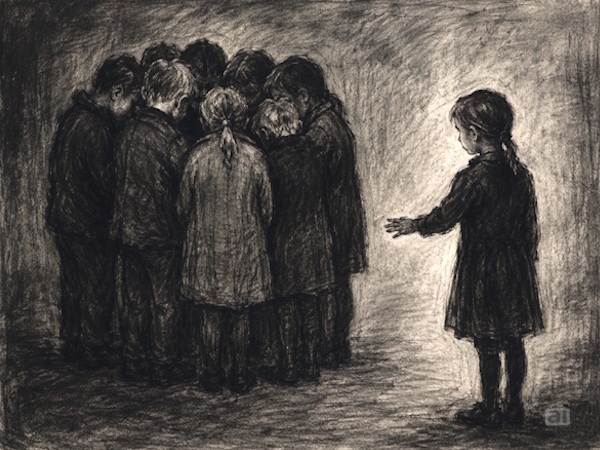
As described in Part 1, a key element is positive power, manifested as a protective authority, speaking in a calm voice that conveys clear expectations and natural consequences without lecturing.
Instances of peer bullying need to be dealt with as soon as they become known, avoiding humiliation and facilitating a rapid return to normal classroom life.
Some Waldorf teachers are particularly good at preventing bullying, dealing firmly with rare instances and cultivating a safe space for all. Others fail to protect victimised children, turning a blind eye or using spiritual concepts to avoid intervention.
But if we value Steinerʼs ideals, we must be instantly aware where their implementation goes wrong.
Who Takes Responsibility?
Most Waldorf Schools do not have a headmaster and operate without a conventional hierarchy. This avoids the rigid structure of comparable institutions but creates its own set of problems:
- Difficult decisions may be passed around endlessly.
- Weak leadership may hide behind consensus language.
- Accountability may become interpersonal rather than structural.
- Protecting collegial relationships may prevent decisive action.
Note: Lehrerrepublik is the self-governance model introduced by Rudolf Steiner for the first Waldorf school in 1919. Instead of a traditional top-down hierarchy or headmaster, it was run collegially by a College of Teachers that made collective administrative and pedagogical decisions.
The shared governance of this Teachers’ Republic creates a setting where everyone is considered equally in charge. But who is going to step forward to shoulder responsibility when leadership is needed?
- Who decides how to act?
- Who communicates with parents?
- Who owns the outcome?
- What happens when colleagues disagree?
Instances of bullying expose a lack of protective authority particularly quickly by revealing weak spots in school governance.
The anthroposophical ideal at the core of Waldorf pedagogy is one thing. Implementing it daily with insightful understanding to create a healthy school culture is quite another.
The first is essential and beautiful; the second remains a perpetual challenge. Waldorf ideals do not automatically produce Waldorf practice.
True Waldorf pedagogy is never passive. It does not use anthroposophical concepts to excuse educational inaction. And our quest to understand the many-layered spiritual component of our students does not eliminate our duty to protect them practically and physically.
Note: As evidence shows, Waldorf settings commonly reduce bullying by their very nature. Research found lower levels of peer cruelty, citing strong class communities, long-term teacher relationships and ethos-driven culture. One study from the 1990s (Sage Journals) found low bullying rates in a case-study school where many pupils had previously experienced victimisation elsewhere. The study suggests that bullying is a situational problem rather than due to the fact that some children are “natural” victims.
Anecdotal evidence from alumni and staff describes that their Waldorf School was proactive and intervention worked well.
Good Waldorf teachers avoid the sarcasm widely used to discipline students. (Sarcasm being in essence a form of self-protection that models bullying from the teacherʼs position of authority.)
But when bullying does occur, some Waldorf Schools respond too slowly, too indecisively or too idealistically. Common complaints point to:
- informal structures lacking external oversight
- a reluctance to intervene strongly
- excessive trust in social processes resolving themselves
- spiritual interpretations that blur accountability
- protecting harmony at the expense of needed action
That being said, neither parents nor pupils can blame Waldorf Schools in general and teachers in particular for not taking action if they were not alerted to bullying at the time it was happening.
The best anti-bullying policy is useless if not rigorously applied by the concerted action of the teaching staff. But to make this possible, the staff needs to be informed right away – not months or years later.
The naïve assumption that teachers know everything, even what is going on behind their back, can lead to unjustified blame.
It is a key element of peer cruelty that perpetrators are highly adept at hiding it, and so the first step must always be that the victim speaks to a trusted adult.
Bullying cannot gain a foothold when the ethos of a school teaches children from the start that there is no shame in telling teachers and parents about hurtful behaviour, making it crystal clear that “telling” is necessary for the protection of all.
When Karma Becomes an Excuse
Some Waldorf parents and alumni report having been told that bullying is personal karma and must be allowed to work itself out without interference.
Such an appalling abdication of essential pedagogical responsibilities is certain to offend parents. And it gives Waldorf Schools bad press.
The karma justification is pretty much in line with facile excuses made elsewhere:
- “It’s all a natural part of growing up.”
- “It builds character.”
- “Children need to toughen up!”
- “Pre-birth, your child chose this experience for itself.”
Even when held to be true, none of it absolves an adult from doing what is right and necessary.
As Waldorf teachers, no matter how profound our understanding of karma might be, we have no pedagogical mandate to speculate to parents about the spiritual causes of their child’s suffering.
And those who take this view would do well to contemplate the karma they might be creating for themselves by choosing not to protect a helpless child in their care.
What Did Steiner Actually Say?
Indeed, it is always disturbing when someone who studies Steiner misapplies his words and perverts their meaning. No less so when it is done innocently and with best intentions.
Let us be clear: Nobody, absolutely nobody can make pronouncements on the karma of individuals who is not an initiate of the highest order. (And if there is such a one currently living among us, it is safe to assume that it is not the bullied child’s class teacher.)
Rudolf Steiner in Lucifer-Gnosis (1903-1908) GA 34:
“In every person’s life, events constantly occur that have nothing at all to do with his past merit or guilt. Such events find their karmic settlement in the future. What happens to me innocently now, I am compensated for in the future. This one thing is correct: nothing remains without karmic compensation. However, whether a person’s experience is the consequence of his karmic past or is the cause of a karmic future: that has to be determined separately. And this cannot be decided by the mind accustomed to the physical world, but only by occult experience and perception.”
It follows that having read Steiner’s Karma Lectures does not qualify a teacher to judge the children’s karma. This study cannot be justification for not stepping in with empathy, protective authority and pedagogical skill to stop hurtful and harmful behaviour.
Certainly, engaging with these lectures benefits teachers with a wider view that sharpens perception and deepens their intimate reflections on the children in their care.
Particular characteristics of their group and its members may make excellent sense when considered from a perspective that takes previous lives into account.
BUT one must not let this private contemplation spill into conversations with concerned parents. Especially not when they are anguished because their child is being bullied.
Telling parents that the children must be left to work out their karma without help is to misread the score of Waldorf pedagogy, thereby playing an egregiously wrong note that grates on the ears and souls of those who hear it.
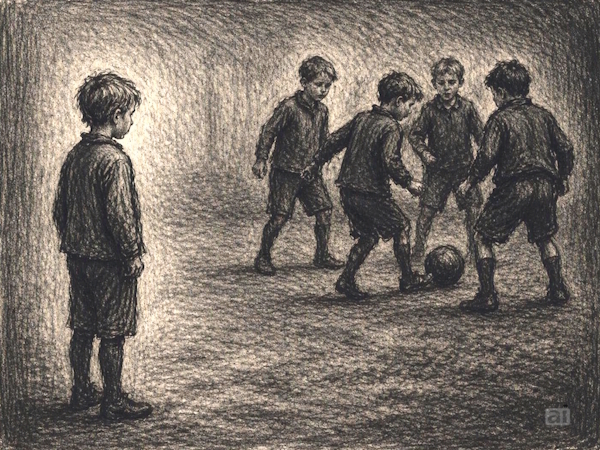
But is it Waldorf?
We sometimes notice an unfortunate tendency to conflate the sublime score of Rudolf Steiner’s pedagogical concepts with their suboptimal interpretation in individual Waldorf Schools.
This lack of distinction is always problematic in discussions about Waldorf education and its aspects.
Is it not obvious that any school’s culture and traditions, the personalities of its teaching staff and the quality of their training – that this (and more) combines to a unique institution which is attuned to the Waldorf ideal by varying degrees from year to year?
In practice, not one of them is (nor can be) a Waldorf School in the purest sense, but they all strive with daily renewed efforts to become one, as outlined in this article:

From this obvious fact two questions arise: At which point does a school become a true Waldorf School? And when does it cease to be one?
Intricately connected: At which point does a new colleague become a Waldorf teacher; namely, a representative of authentic Waldorf pedagogy?
Not with the signing of the employment contract – that much is certain. But this is a topic for another day.
The Teacher Makes the Difference
In Waldorf education, the inner development of the teacher is paramount to creating a safe haven for students. This truth is perfectly expressed in a famous quote by the pioneering child psychologist Haim Ginott in his 1972 book Teacher and Child:
“I have come to the frightening conclusion that I am the decisive element. It is my personal approach that creates the climate. It is my daily mood that makes the weather. I possess tremendous power to make life miserable or joyous. I can be a tool of torture or an instrument of inspiration, I can humiliate or humor, hurt or heal. In all situations, it is my response that decides whether a crisis is escalated or de-escalated, and a person is humanized or de-humanized. If we treat people as they are, we make them worse. If we treat people as they ought to be, we help them become what they are capable of becoming.”
In his blog post on the book, Chris McNutt states, “Ginott’s work is a masterpiece on understanding relationship-building, which is the cornerstone to an effective education, while not diminishing problems that should be solved.”
Adele Faber and Elaine Mazlish, having attended Ginott’s workshops, transformed their notes into the international bestselling guide for teachers and parents How to Talk So Kids Will Listen that also found its way onto the bookshelf of many a Waldorf teacher and training seminar.
The educational progress which Ginott’s work inspired rests on the concept of communicating with compassion. And his emphasis on the emotional leadership required of adults to prevent peer cruelty meshes harmoniously with Steinerʼs views on the spiritual and moral authority of the educator.
The third part of this article shows more ways of meeting peer cruelty with decisive action …
Its lesson plans teach the children – A WALDORF DIARY teaches the teacher